

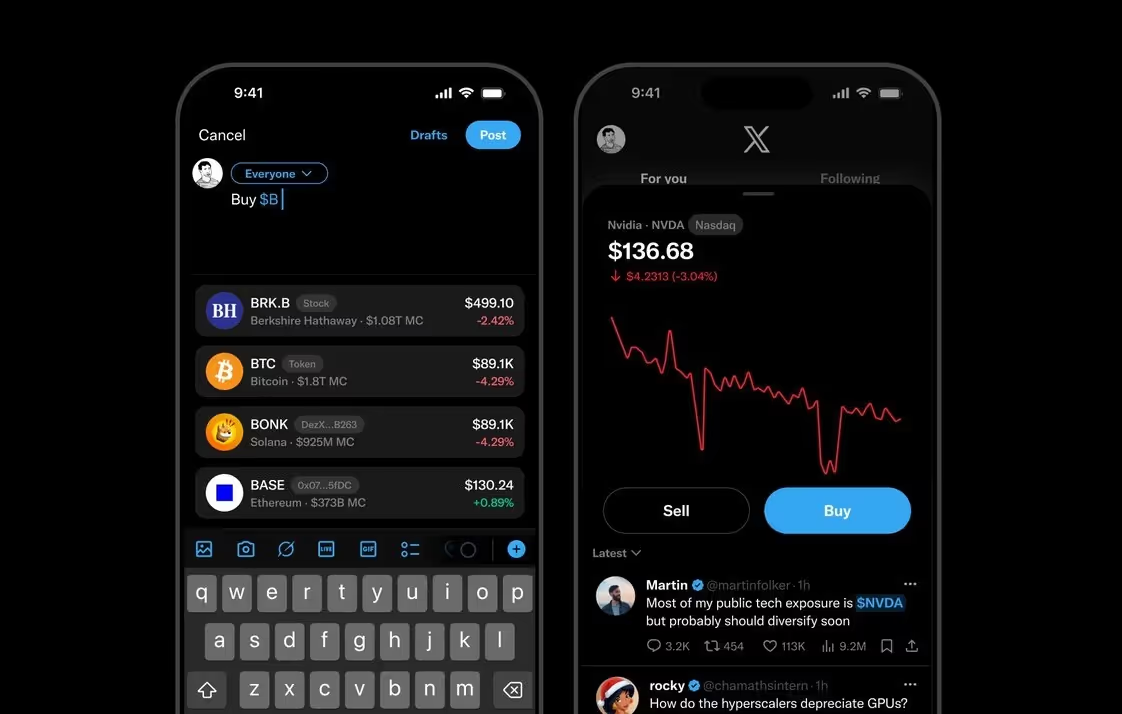
X announced on January 11, 2026, that it will roll out Smart Cashtags in February, embedding live price tracking for crypto assets and publicly traded equities directly inside user timelines. The feature exposes real-time market data to more than 550 million monthly active users, according to X Head of Product Nikita Bier's announcement on the platform. Cashtags like $BTC, $ETH, $TSLA, and $NVDA will expand into interactive price modules showing current prices, short-term charts, and related discussions without requiring users to leave the app.
This collapses three traditionally separate layers—price discovery, market commentary, and crowd reaction—into a single surface. According to product mockups shared by Bier, tapping a Smart Cashtag surfaces spot pricing with data latency optimized for mobile under 200 milliseconds, alongside a scrollable feed of posts referencing the same asset. Price data is sourced from third-party providers, with crypto cashtags linking directly to specific smart contracts for "almost real-time" on-chain data, according to CryptoTimes coverage of the technical specifications. Markets are no longer something users check before or after social media—they are embedded inside it.
How Information Hierarchy Disappears When Price Meets Sentiment
Smart Cashtags transform any ticker prefixed with a dollar sign into a live market object. Assets shown in preview screenshots range from traditional equities like Berkshire Hathaway ($BRK.B) to Solana ecosystem meme tokens like $BONK, indicating X is treating crypto as a first-class asset category alongside regulated securities. This matters because a user scrolling past a post is no longer choosing to analyze markets—the market appears uninvited, alongside opinions, memes, and emotionally charged commentary.
Traditional platforms like TradingView or CoinMarketCap separate analysis from reaction by design. X fuses them. Research from the University of Chicago Booth School published in 2024 showed that traders exposed to sentiment and price simultaneously increased short-term trading frequency by 21% compared to price-only dashboards, according to Bank for International Settlements working paper 1000 on behavioral finance. When price, narrative, and social reinforcement collide inside a single interface, feedback loops tighten. A viral post referencing a thinly traded token now sits one tap away from its live price, lowering cognitive friction between excitement and action.
Bier noted in his announcement that "hundreds of billions of dollars are deployed based on things people read" on X, framing Smart Cashtags as formalizing the platform's existing influence on financial decisions. The feature attempts to solve a practical problem—ticker symbol confusion, particularly in crypto where overlapping symbols exist across chains—but the secondary effect is more significant. X removes intent from price exposure. Users don't seek market data; it appears passively and constantly within their social feed.
Retail Trading Volume Already Justifies X's Bet on Market Integration
Retail investors reached 36% of total U.S. equity order flow on April 29, 2025, marking an all-time high, according to J.P. Morgan analysis cited by ARC Group. This compares to pre-pandemic levels when retail order flow rarely exceeded 10% of daily trading volume. More recent data from MEMX's August 2025 Retail Trading Insights estimates retail now accounts for 30% to 37% of daily U.S. equity volume depending on market conditions, demonstrating sustained elevation rather than temporary pandemic-era behavior.
Crypto markets show even higher retail concentration. Over 62% of crypto spot volume originates from retail-dominated venues, compared to under 18% in U.S. equities, according to CoinGlass market data from November 2025. This structural difference makes crypto assets more sensitive to sentiment velocity—exactly what X's Smart Cashtags amplify by embedding price context directly into social discussions. During October 2025's Solana memecoin surge, five-minute volatility windows spiked 37% immediately following large social engagement bursts on X, according to on-chain data tracked by CoinMetrics.
The distinction between displaying information and facilitating trades matters less than regulatory frameworks assume. X does not execute trades, but it shortens the psychological distance to execution. Behavioral finance research consistently shows that passive exposure changes risk tolerance. The 2023 BIS working paper found traders exposed to continuous price updates increased impulsive trade execution by 19%, even when execution platforms remained unchanged. Smart Cashtags create exactly that environment—constant price visibility without deliberate information-seeking behavior.
Why Equities Sharing Crypto's Surface Changes Market Dynamics
The more subtle shift is that regulated equities now share the same interface mechanics as crypto. Smart Cashtags support U.S. listed stocks and ETFs starting with S&P 500 constituents, according to Bier's product announcement, with gradual expansion planned. This places highly regulated assets inside an environment historically driven by speed, narrative, and polarization rather than fundamental analysis. The difference is scale—Crypto Twitter already shaped markets through coordinated attention. Stock Twitter now inherits identical mechanics applied to $60 trillion in U.S. equity market capitalization.
X has obtained money transmitter licenses in more than 25 U.S. states, signaling preparation for payment services expansion that may include crypto, according to regulatory filings analyzed by CryptoTimes. While X has not confirmed in-app trading functionality, concept screenshots showing "Buy" and "Sell" buttons sparked speculation that execution layers would follow through partnerships with regulated brokers or crypto platforms. Before trading comes observation. Before custody comes attention. Live market data is foundational infrastructure for Elon Musk's stated "everything app" vision.
The Case That X Is Simply Displaying Public Information
Supporters argue X merely aggregates data already available through dozens of other platforms. Prices exist publicly. Charts circulate freely. According to X executives' framing in product documentation, the platform does not provide trading functionality and therefore does not alter market access—it improves information accessibility for financial discussions already happening at scale on the platform.
That argument has merit. Execution still happens elsewhere through regulated channels. Responsibility remains with individual users who choose to act on information. Markets survived CNBC tickers, Bloomberg terminals, and smartphone apps before X. Those systems preserved friction by requiring intentional information-seeking. Users opened specific apps or turned on financial television to check prices. X removes that intent requirement entirely. Exposure becomes passive, ambient, and constant.
The question regulators will face is whether collapsing the gap between social sentiment and price data accelerates market manipulation or merely makes existing dynamics more visible. X already influences billions in capital allocation through posts that go viral. Smart Cashtags formalize rather than create that influence. The platform positions itself as neutral infrastructure displaying objective market data alongside user discussions—a framing that conveniently ignores how information architecture shapes behavior.
What February's Launch Tests About Attention and Capital Flows
Smart Cashtags will not create a bull market or guarantee manipulation. The feature does something more structural and durable—it changes how markets are observed by hundreds of millions of users who may have never checked asset prices deliberately. When prices, opinions, and reactions share the same scrolling surface, cycles compress. Narratives accelerate. Corrections may arrive faster as misinformation spreads at social media velocity rather than traditional financial media timelines.
Crypto traders will feel impacts first as meme tokens and smaller-cap assets gain instant visibility alongside Bitcoin and Ethereum. Equity investors will notice effects during earnings cycles and macro announcements when price movements and social reactions compound in real-time. Regulators will respond last, likely after Smart Cashtags demonstrate measurable influence on volatility patterns or raise concerns about retail investor protection in an environment blending entertainment and financial decision-making.
JP Morgan's market microstructure analysis from December 2025 noted that compressed information cycles tend to increase short-term volatility while potentially reducing long-term mispricing, according to research on how faster information distribution affects price discovery. X's integration is neither inherently bullish nor bearish for asset prices—it is a structural change in how financial information reaches the largest social media audience globally. The timeline is no longer just commentary about markets. Starting February, it becomes part of the market infrastructure itself.


.png)