
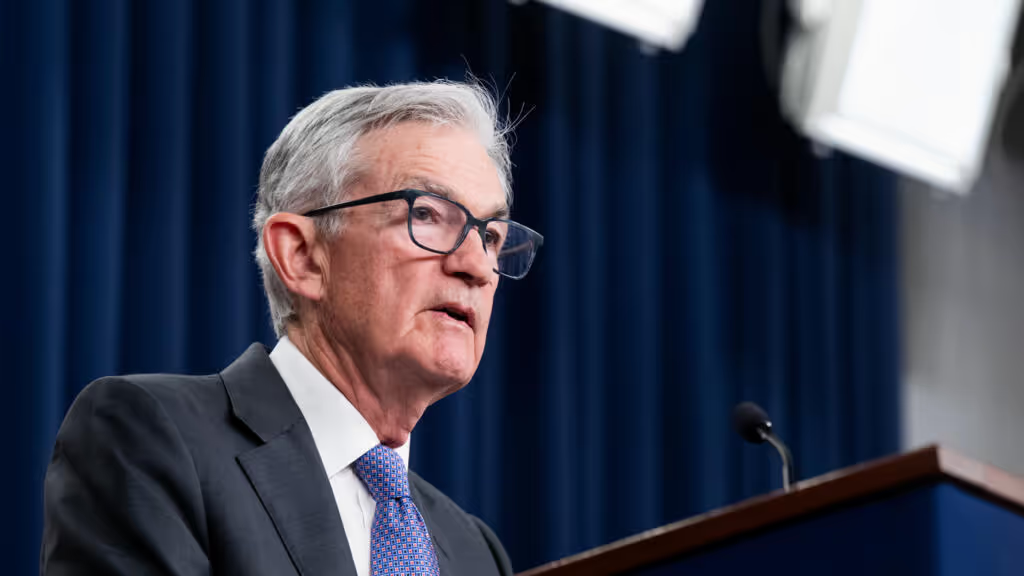
Federal Reserve Chair Jerome Powell revealed January 11, 2026, that the Department of Justice served the central bank with grand jury subpoenas Friday threatening criminal indictment related to his June 2025 congressional testimony about the Fed's $2.5 billion headquarters renovation. Powell's forceful video and written statement characterized the action as political pressure targeting Fed independence rather than legitimate oversight of construction cost overruns, according to Powell's official statement posted on the Federal Reserve website. The announcement triggered immediate market dislocations. Gold surged to an all-time record of $4,640 per ounce on Monday before stabilizing near $4,624, silver topped $86 per ounce, the U.S. Dollar Index fell 0.34% to 98.79 marking its lowest level in nearly a decade, and 10-year Treasury yields spiked to 4.20% as investors priced in a political risk premium on American sovereign debt, according to Bloomberg market data tracking Monday's trading session.
This marks the first time in modern Federal Reserve history that a sitting chair has faced the threat of criminal prosecution. The subpoenas arrived January 9-10, 2026, from the U.S. Attorney's Office for the District of Columbia, led by U.S. Attorney Jeanine Pirro, a former New York prosecutor and Fox News host appointed by President Trump. The investigation centers on whether Powell's Senate Banking Committee testimony contained false statements regarding features and costs of the renovation project, which increased from original estimates to roughly $2.5 billion.
Powell Frames Subpoenas as Monetary Policy Pressure Campaign
Powell's statement explicitly linked the DOJ action to broader administration pressure on interest rate decisions. "This new threat is not about my testimony last June or about the renovation of the Federal Reserve buildings," Powell stated. "The threat of criminal charges is a consequence of the Federal Reserve setting interest rates based on our best assessment of what will serve the public, rather than following the preferences of the President," according to NPR's analysis of the full statement.
The timing matters because President Trump has repeatedly demanded more aggressive rate cuts throughout 2025. The Fed cut rates at each of its last three meetings, but Trump has been outspoken about wanting much lower rates faster. Trump threatened to fire Powell in December 2025, stating "We're thinking about bringing a suit against Powell for incompetence," claiming the renovation would "end up costing more than $4 billion" and calling it the "highest price of construction per square foot in the history of the world," according to CNBC reporting on Trump's December 29 remarks.
When asked Sunday night about Powell's assertion that subpoenas were designed to pressure rate policy, Trump told NBC News: "No. I wouldn't even think of doing it that way. What should pressure him is the fact that rates are far too high." Trump also claimed he knew nothing about the DOJ probe, stating "I don't know anything about it, but he's certainly not very good at the Fed, and he's not very good at building buildings," according to NBC reporting.
What Markets Are Pricing: Independence Premium Evaporation
The market reaction reflects investors pricing in what analysts call an "institutional risk premium" or "independence discount" on U.S. assets. When central bank credibility comes into question, several pricing channels activate simultaneously. Gold's surge to $4,640 per ounce represents investors viewing the precious metal as insurance against breakdown in American monetary governance, not just inflation hedging. Julius Baer Group's Carsten Menke noted "We see increased interference with the Fed as a key bullish wildcard for the precious metals in 2026," according to Bloomberg's precious metals analysis.
The dollar's 0.34% drop to 98.79 on the Dollar Index reflects capital flight from perceived systemic risk. When the world's reserve currency issuer faces questions about monetary policy independence, safe-haven flows reverse. The euro and Indian rupee saw sharp gains as international investors repriced political risk, according to financial market tracking data. The 10-year Treasury yield spike to 4.20% represents what analysts describe as "bear steepening" of the yield curve—short-term rates remained stable on hopes of future cuts, but long-dated yields jumped as the term premium widened. Term premium is the extra compensation investors demand for holding long-term debt when uncertainty about future policy increases.
"The possible Fed indictment is a reminder of how many uncertainties markets are juggling—geopolitics, the growth/rates debate, and now a fresh headline-driven reminder of an institutional risk premium," said Charu Chanana, chief investment strategist at Saxo Markets, according to Bloomberg analysis. Krishna Guha, head of global policy and central banking strategy at Evercore ISI, noted "On the face of it, it looks as if the administration and the central bank are now in open war—something Powell and Treasury Secretary Bessent have tried strenuously to avoid."
The Renovation Project That Became a Political Flashpoint
The headquarters renovation has been underway for several years as a multiphase project to modernize historic Federal Reserve buildings in Washington. Cost projections increased from $1.9 billion to $2.5 billion, with some estimates now suggesting figures above $3 billion. During his June 2025 Senate Banking Committee testimony, Powell addressed criticism about perceived extravagance, disputing claims about "special elevators," new water features, and rooftop gardens made by Office of Management and Budget Director Russell Vought, according to CBS News coverage of the June hearing.
Powell told lawmakers there is no new marble aside from what's necessary to replace broken historic marble. The Fed brought in its inspector general to review the project following Trump administration criticism. Bloomberg reported Monday that Federal Housing Finance Agency Director Bill Pulte was the instigator behind the Powell subpoena, though Pulte stated Monday that the Justice Department is "out of my purview" and he didn't "know anything about it," according to CBS reporting. The Government Accountability Office is separately investigating Pulte for his actions at FHFA.
The legal standard for indicting a public official for misleading Congress requires proof of knowledge and intent, not just inconsistency in statements. Criminal inquiries and subpoenas are early evidence-gathering steps—many DOJ investigations do not progress to formal charges, particularly when targeting officials whose statements reflect evolving project information. Rep. Anna Paulina Luna (R-Fla.) first referred Powell to DOJ in July 2025 for potential perjury and false statements related to the renovation testimony.
Political Reactions Split Along Institutional Independence Lines
The episode triggered reactions across the political spectrum reflecting different views on Fed autonomy versus oversight accountability. Senator Thom Tillis, a Republican on the Senate Banking Committee, stated he may block confirmation of any Fed nominees, including Powell's successor, until the legal matter is resolved. Powell's term as chair expires May 2026, though his term as a Fed governor extends through January 2028. Some analysts suggest Powell may remain as a governor after his chair term ends to prevent Trump from filling the vacancy, according to Annex Wealth Management analysis.
Democratic lawmakers criticized the probe as institutional attack. Senator Chuck Schumer and Senator Elizabeth Warren voiced concerns about political interference in monetary policy. White House economic adviser Kevin Hassett acknowledged the probe exists but said he was not involved in DOJ discussions, while reiterating respect for both institutions' independence. Hassett suggested scrutiny of high construction costs is reasonable even as Powell frames the threat as politically motivated. Several central bankers globally publicly defended Fed independence and Powell's leadership, underlining that central bank autonomy is widely viewed by policymakers as critical to financial stability, according to international regulatory commentary.
The August 2025 Lisa Cook Case Provides Legal Context
This is not the first time the Trump administration has used legal mechanisms to target Fed officials. In August 2025, the administration attempted to fire Fed Governor Lisa Cook "for cause" citing decade-old allegations of mortgage fraud. That move led to ongoing litigation, with the Supreme Court case Trump v. Cook scheduled for oral arguments January 21, 2026, according to legal tracking of the Supreme Court docket. The Supreme Court ruled Cook can remain on the Fed's governing board pending the case outcome.
The Cook case established a pattern: use "for cause" removal authority or criminal investigation to create legal jeopardy for Fed officials who resist administration policy preferences. The Federal Reserve Act provides governors with fixed terms and limits presidential removal power to protect monetary policy from short-term political pressure. If the Supreme Court rules in Trump v. Cook that the administration has broad removal authority, it would fundamentally alter the Fed's independence framework.
Markets Face Two Competing Scenarios for 2026 Policy
The DOJ action creates conflicting pressures on Fed decision-making. In one scenario, the Fed maintains its current policy path to demonstrate it will not be intimidated by legal threats. Market consensus suggests the Fed will hold rates at 3.5% to 3.75% at its January 29 meeting to signal independence. Analysts at JPMorgan suggest the Fed may remain "on hold" throughout much of 2026 to avoid the appearance of capitulation—ironically achieving the opposite of the administration's desired aggressive rate cuts, according to analyst notes tracking FOMC expectations.
In the competing scenario, Powell's departure—either through resignation, indictment forcing recusal from policy duties, or the May 2026 term expiration—allows appointment of a successor more aligned with administration preferences. Names floated include National Economic Council Director Kevin Hassett and Kevin Warsh. A successor perceived as politically compliant would fundamentally change market expectations about future policy paths. Investors would price in higher probability that rate decisions reflect political timelines rather than data-dependent frameworks.
The ongoing government shutdown has created gaps in economic data releases, making it difficult for the FOMC to justify major policy moves with comprehensive data. Most analysts now expect only one or two 25-basis-point cuts for the entire year, provided the institutional crisis does not escalate further, according to Fed Funds futures pricing.
The Historical Parallel Markets Keep Citing
When discussing political pressure on central banks, analysts repeatedly reference the 1970s Federal Reserve under Arthur Burns. That era featured direct White House pressure on monetary policy during the Nixon administration, contributing to the "Great Inflation" that required years of painful rate hikes under Paul Volcker to correct. Burns later acknowledged that Fed policy was influenced by political considerations, compromising the institution's inflation-fighting credibility.
The key difference in 2026 is the use of criminal investigation as the pressure mechanism rather than private White House meetings. This shift from "backroom arm-twisting" to "grand jury subpoenas" represents an escalation in tactics. If markets conclude that future Fed chairs face criminal jeopardy for resisting administration rate preferences, the credibility framework supporting dollar dominance and Treasury market depth erodes structurally.
Why No Formal Charges Does Not Eliminate Risk Premium
A critical limitation in assessing market impact is that no formal criminal charges have been filed as of mid-January 2026. Subpoenas are procedural evidence-gathering steps. Historically, many DOJ inquiries targeting public officials do not result in indictments, especially when the alleged false statements involve evolving project details rather than clear factual misrepresentation. The investigation may remain in evidence-gathering mode without progression to charges.
That possibility does not eliminate the market risk premium because the mere existence of criminal investigation targeting a sitting Fed chair was historically negligible probability. Even if charges never materialize, the precedent is established: administration displeasure with monetary policy can trigger criminal investigation of the chair. Future chairs will operate knowing this tool exists in the executive branch arsenal. That knowledge alone alters the decision calculus for central bankers, regardless of whether Powell specifically faces prosecution.
The banking and financial services sectors have been primary victims of institutional uncertainty. Major institutions including JPMorgan Chase, Bank of America, and Goldman Sachs saw stock price volatility as markets tried to price risk of a "politicized" interest rate environment. Banks are sensitive to shifts in term premium because it affects long-term funding costs and lending margins, according to sector analysis tracking financial stocks.


.png)