


For years, crypto operated in a gray zone. Not illegal, not invisible, but rarely coordinated across borders. That phase is ending. Quietly, methodically, and faster than most traders expect.
According to the OECD's Crypto-Asset Reporting Framework (CARF) documentation, 48 jurisdictions have committed to launching automatic exchanges of crypto tax data by 2027. Greece and the United Kingdom are both included in the first wave.
What matters more is not the exchange year. It is the data collection year. That starts in 2026. By the time information is shared in 2027, the activity that triggered it will already be on record.
What CARF Actually Is and Why It Changes Everything
CARF is a global reporting framework designed by the OECD to close what regulators describe as a structural tax gap in crypto markets. Traditional financial institutions already fall under the Common Reporting Standard (CRS). Crypto platforms largely did not.
CARF extends similar logic to crypto-asset service providers. Under the framework, exchanges and platforms classified as Reporting Crypto-Asset Service Providers must collect and report user transaction data to national tax authorities. Those authorities then exchange the information with other participating jurisdictions.
In practical terms, this removes the long-standing assumption that trading on a foreign platform shields activity from domestic tax visibility. According to OECD implementation guidance, the goal is consistency: crypto gains treated like other cross-border financial income, not as an exception.
The Countries Moving First in 2027
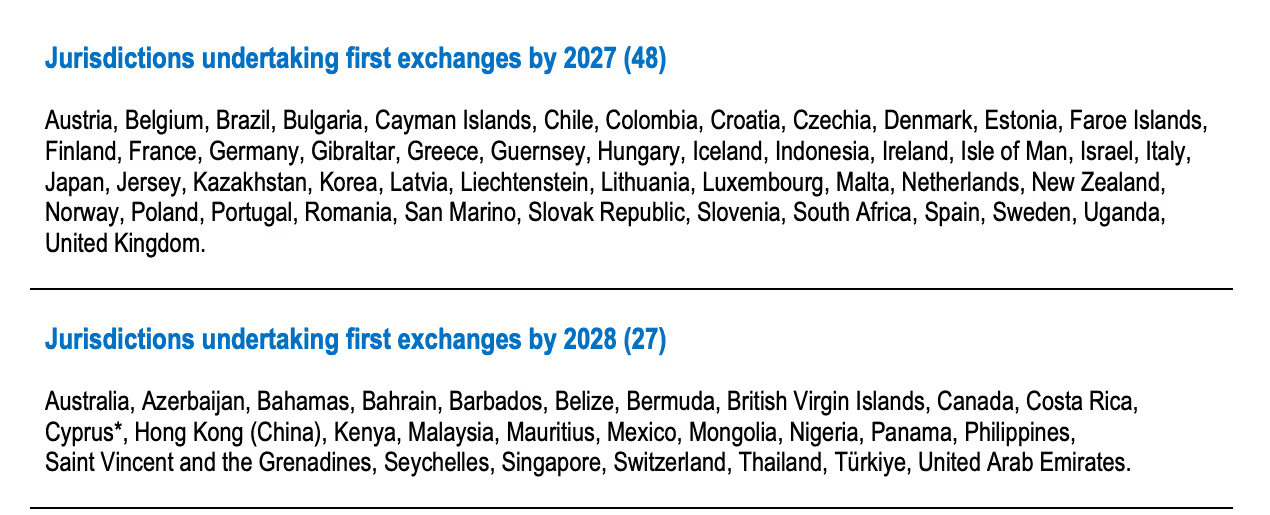
The first group includes 48 jurisdictions: Greece, the UK, Germany, France, Italy, Spain, the Netherlands, Austria, Belgium, Ireland, Portugal, and most of the European Union. Several non-EU jurisdictions are also involved, including Japan, South Korea, Brazil, South Africa, New Zealand, and Israel.
[IMAGE PLACEHOLDER: Insert CARF jurisdiction table here]
For users based in Greece or the UK, this matters immediately. These countries are not late adopters. They are part of the initial reporting wave.
A second group of 27 jurisdictions plans to follow in 2028, including Cyprus, Switzerland, Singapore, Hong Kong, the UAE, Canada, and Australia. The United States has indicated participation from 2029, operating meanwhile under its own domestic reporting rules through the IRS.
Why 2026 Matters More Than the Headlines Suggest
Most public discussion focuses on 2027 as the start date. That framing is misleading.
Data exchange requires data to exist. To exchange information in 2027, platforms must start collecting it in 2026. That makes 2026 the first effective reporting year. Trades executed during that year are the ones that will later appear in cross-border tax files.
This creates a structural shift. Activity that took place before reporting frameworks existed could fall into legal ambiguity. Activity from 2026 onward will not.
According to CARF technical specifications, the framework is designed so jurisdictions can reconstruct annual crypto activity with enough detail to perform tax matching, even without granular on-chain analysis.
Reported data includes user identification details, tax residency, annual totals of crypto purchases and sales, crypto-to-crypto exchanges executed on the platform, and transfers facilitated by the platform. This is sufficient for authorities to reconcile declared income with platform-reported activity.
Europe Adds Another Layer with DAC8
For EU users, CARF does not arrive alone. It is implemented in parallel with DAC8, the EU directive that harmonizes crypto reporting across member states. DAC8 aligns directly with CARF but adds European enforcement mechanisms.
For Greece, this means three layers of oversight: national tax reporting through AADE (Independent Authority for Public Revenue), EU-wide data sharing under DAC8, and global exchange through CARF.
The effect is cumulative. Even if one system misses data, others are designed to catch it. According to European Commission briefings, DAC8 is explicitly aimed at preventing regulatory arbitrage inside the EU. Moving activity from one member state to another does not remove reporting obligations.
What This Means for Traders and Investors
This does not signal a ban on crypto. It signals normalization.
Crypto is being integrated into the same reporting infrastructure that governs traditional assets. Anonymity decreases. Cross-border visibility increases. Non-reporting becomes harder to justify. Trading on offshore platforms no longer implies being outside the system. Platform choice does not override tax residency.
For casual users, this increases the importance of basic record-keeping. For active traders, it raises the cost of ignoring tax compliance. Enforcement tends to lag implementation by a year or two. That does not reduce risk. It concentrates it.
The key shift is not that crypto is becoming regulated. That has been happening for years. The shift is that crypto tax data is becoming interoperable across borders. Once that infrastructure exists, reversing it becomes politically and technically unlikely.
The real inflection point is 2026. That is when activity starts being logged in a way designed for international exchange. Ignoring that does not make it disappear. It simply delays awareness until enforcement arrives.


.png)