
.avif)
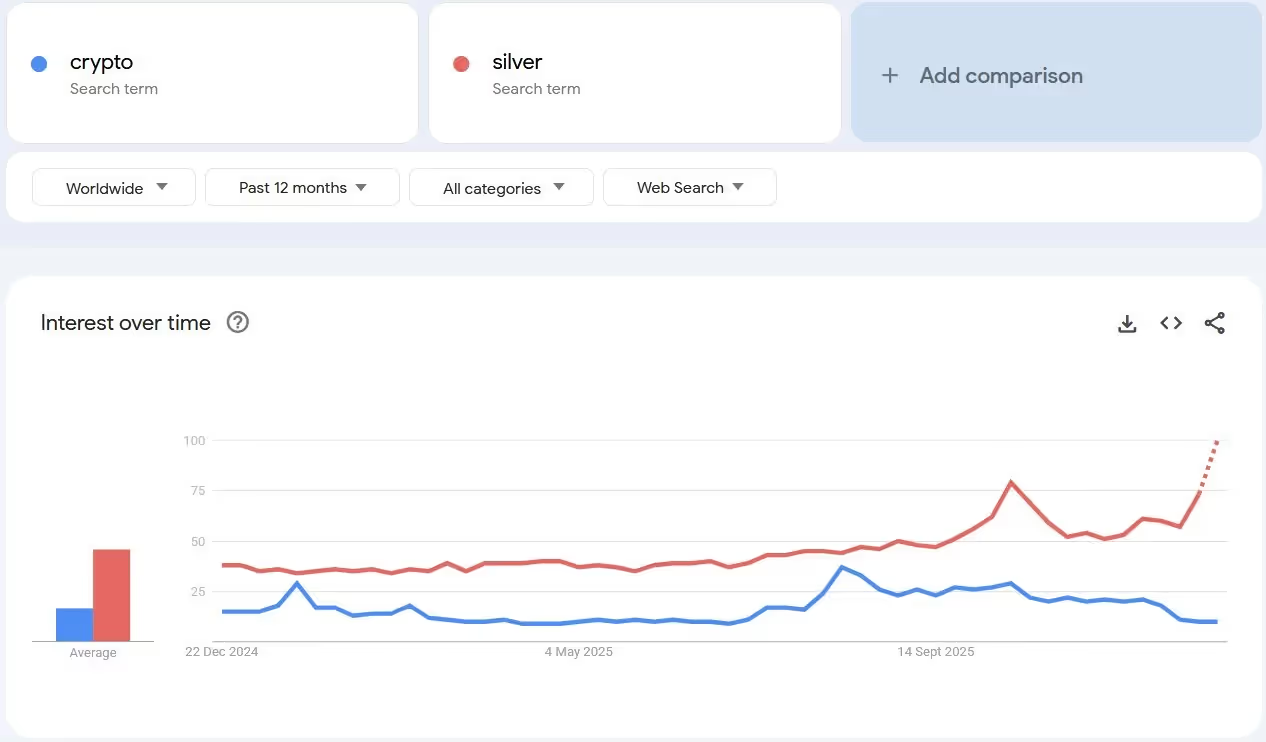
Markets telegraph major shifts through attention before price. Over the past twelve months, Google Trends data shows a clear divergence: search interest for "crypto" has slipped to twelve-month lows, while "silver" has broken out to near-peak levels. This isn't noise. When retail curiosity moves, capital follows.
The pattern arrives at an interesting moment. Silver surged 63% in 2025—from $32/oz in January to $52/oz by December according to COMEX futures data. Meanwhile, crypto sentiment reset to levels that historically precede either extended accumulation or structural narrative shifts. The divergence reveals where attention is going, not where it's been.
What Google Trends Measures and Why It Matters
Google Trends doesn't measure buying or selling. It measures attention—specifically, how frequently a term is searched relative to all other searches at a given time.
Search interest for "crypto" hasn't collapsed suddenly. It's faded gradually. Each spike throughout 2025 became smaller, each rebound weaker. By year-end, the trend sits at twelve-month lows. This isn't Bitcoin-specific or ETF-specific data—it's the broad term "crypto." The general audience has stopped asking basic entry questions. Retail curiosity has stalled.
Historically, these fatigue phases don't always coincide with crashes. More often, they mark periods when retail participation fades, discussions disappear from mainstream channels, and narratives lose oxygen. That silence tends to precede something important—either extended consolidation or the quiet formation of a new cycle.
Silver's Breakout Has Structural Drivers
While crypto attention fades, silver searches are doing the opposite. Google Trends shows clear upward trajectory throughout 2025, capped by sharp acceleration in recent weeks.
Silver is no longer framed solely as "poor man's gold." It sits at the intersection of investment demand and industrial utility. Solar panels, electric vehicles, AI infrastructure, and advanced electronics all rely heavily on silver inputs. According to the Silver Institute's 2025 demand data, industrial consumption now accounts for over 54% of annual silver usage—a structural shift from prior cycles when investment demand dominated.
The supply side adds pressure. China controls 60-70% of global refined silver supply according to USGS mineral commodity data. Starting January 1, 2026, China's Ministry of Commerce is implementing export licensing requirements with 80-ton minimum annual production capacity thresholds—effectively sidelining hundreds of smaller exporters. As covered in the Holiday Week Market Risk analysis, even the perception of tighter supply has historically been enough to spark renewed speculative interest.
What This Divergence Signals
This chart isn't a buy or sell signal. It shows where attention is going.
When crypto search interest declines, retail participation fades, market liquidity thins, and price discovery becomes driven by fewer players. When interest in traditional assets like silver rises, the narrative migrates into mainstream media, risk-off investors re-enter the conversation, and "safety" stories regain appeal.
Markets tend to follow recurring psychological cycles. Sharp spikes in precious metals interest typically reflect rising macro anxiety—inflation concerns, interest-rate uncertainty, geopolitical stress, supply-chain disruption. Capital starts seeking protection. And crypto, at least narratively, isn't offering that story right now.
The Counterargument That Makes Both Camps Uncomfortable
Here's the uncomfortable irony for crypto skeptics: historically, some of the strongest rallies began when nobody was talking about crypto, search interest was depressed, and retail investors were disengaged.
When everyone is talking, markets are usually late. When no one is paying attention, something is often being built quietly underneath. This doesn't imply an imminent bull market. It suggests sentiment has reset to levels that, in prior cycles, preceded structural change rather than collapse.
According to behavioral finance research compiled by CFA Institute, extreme apathy often proves more constructive than extreme enthusiasm. The absence of retail euphoria removes one of the classic top signals from the current market structure.
Where Attention Goes, Capital Follows
Google Trends doesn't forecast prices. It captures psychology.
Right now, psychology looks like this: crypto shows fatigue, silence, disengagement. Silver shows renewed focus, macro fear, capital preservation instincts. When two asset classes move in opposite directions at the attention level, it signals a shift in the broader macro narrative.
Whether this resolves into renewed crypto strength or deeper rotation toward traditional assets remains open. But one conclusion is difficult to ignore. Markets speak first through attention, not price. At this moment, attention has clearly changed sides.


.png)