

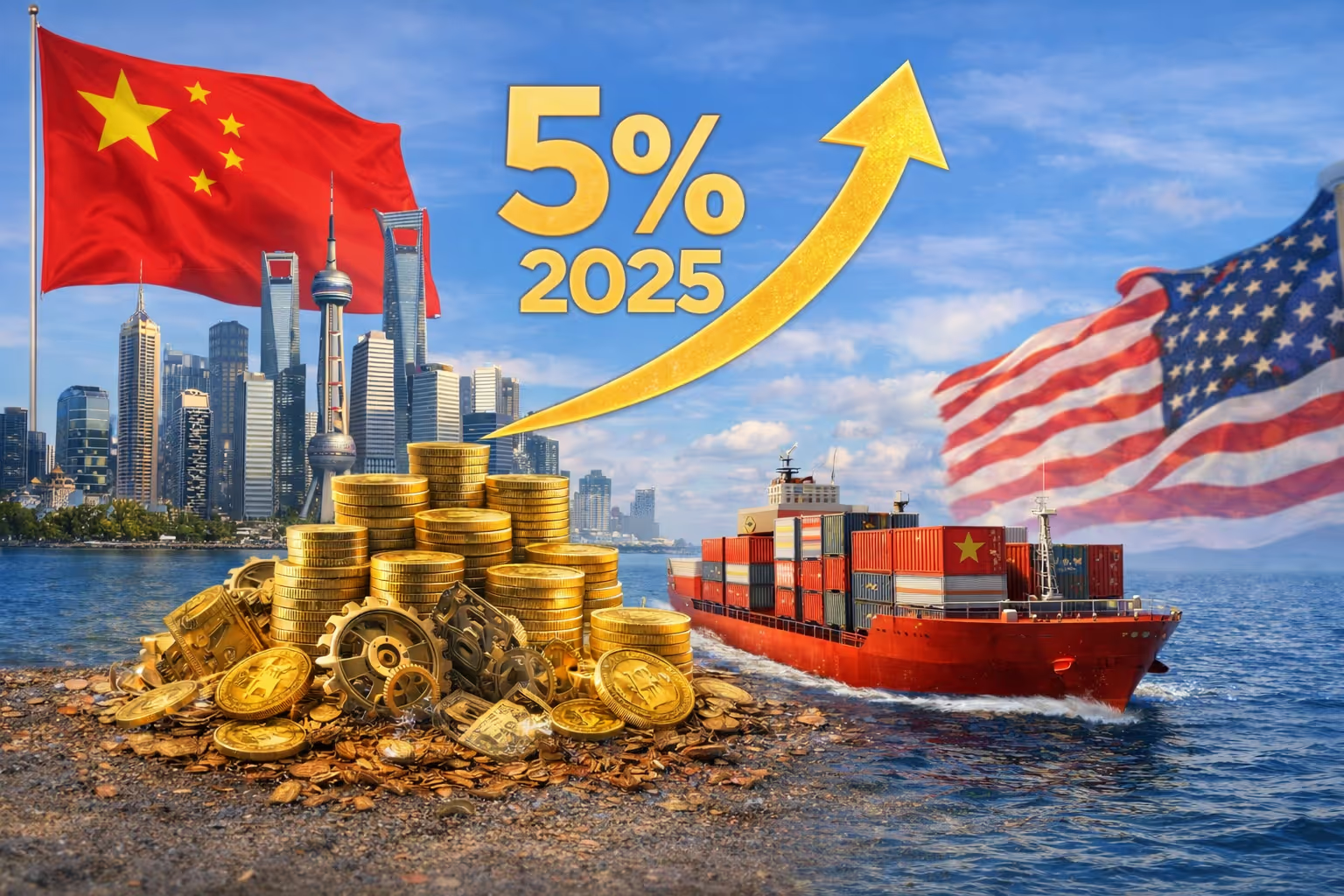
China closed 2025 with an official GDP growth rate of 5%, hitting the government's long-standing target despite continued trade pressure from the United States. According to data released by China's National Bureau of Statistics in January 2026, the world's second-largest economy expanded at a pace that many global institutions had considered increasingly difficult to achieve under the current geopolitical and domestic constraints according to CGTN.
On paper, the number looks solid. In context, it is more complex.
The 5% figure matters not only because of its absolute value, but because it comes after two years of slowing momentum, capital outflows, a deep property sector downturn and an escalating strategic rivalry with the United States. The question is not whether China grew. It is how that growth was achieved, and how durable it is.
Exports Carried the Headline Growth
The backbone of China's 2025 expansion was external demand.
Despite U.S. tariffs remaining in place across multiple categories, China recorded a record trade surplus of roughly $1.2 trillion in 2025, driven largely by strong exports to Southeast Asia, Latin America and the Middle East rather than the U.S. itself according to NPR.
This matters because it shows China did not "beat" the trade war by winning in the U.S. market. It adjusted its trade geography.
Manufactured goods ranging from electric vehicles to industrial machinery continued to flow at scale, supported by state-backed financing, preferential logistics and aggressive pricing. In practical terms, Beijing offset U.S. pressure by deepening commercial links elsewhere.
From a macro standpoint, this reshaping of export flows allowed China to maintain industrial output growth even as parts of the Western market became more restrictive. That is resilience, but not the kind that comes from rising household consumption or organic private investment.
It is resilience built on volume and policy leverage.
Domestic Demand Remains the Weak Link
Where the picture becomes less flattering is inside China's borders.
While annual growth reached 5%, quarterly momentum deteriorated into year-end. China's economy expanded only around 4.5% year-on-year in Q4 2025, the slowest quarterly pace since 2022 according to Al Jazeera.
This slowdown reflects persistent weakness in household consumption, private investment and real estate activity. Retail sales growth remained muted relative to pre-pandemic norms, while the property sector continued to drag on credit creation and local government revenues.
China has not replaced property-driven growth with consumer-driven growth. Instead, it substituted one policy-dependent engine with another: exports and state-supported manufacturing.
This raises a structural question. An economy can lean on exports for only so long when domestic income growth does not accelerate in parallel.
Trade War Pressure Did Not Break Growth, But It Changed Its Shape
It is tempting to frame the 5% growth as a direct defeat of U.S. trade pressure. That framing is misleading.
Trade tensions between China and the U.S. remain unresolved, with tariffs, export controls and investment restrictions still in place across technology, semiconductors, EVs and advanced materials. The U.S. tariff rate on Chinese goods currently stands at 47.5% according to The Hill.
What changed in 2025 was not the pressure itself, but China's adaptation to it.
Rather than restoring its previous export relationship with the U.S., China accelerated supply chain regionalisation and export diversification. For the whole of 2025, China's exports to the U.S. fell 20%. In contrast, exports to Africa surged 26%, to Southeast Asian countries jumped 13%, to the European Union 8%, and to Latin America 7% according to ABC News.
In other words, China absorbed the shock, but it did not neutralise it.
That distinction matters for future volatility.
The Counterargument: Are the Numbers Telling the Full Story?
A necessary part of any serious China GDP analysis is acknowledging skepticism around official data.
Several independent research groups have long argued that China's reported growth rates tend to smooth volatility and overstate underlying momentum during periods of stress. Research firms such as Rhodium Group estimate that China's actual economic growth may have been meaningfully lower than official figures in recent years, based on electricity consumption, freight volumes and corporate profitability.
This does not mean the 5% figure is fabricated. It does mean that the margin of error is higher than in most developed economies, short-term stabilisation policies can temporarily inflate growth, and structural fragility may not be visible in annual averages.
In that sense, the 5% figure should be read as a political-economic achievement, not purely a market-based one.
Why This Growth Matters for Markets
From a market perspective, China's ability to maintain 5% growth carries several implications.
First, it reduces immediate downside risk for commodity exporters and emerging markets tied to Chinese demand. Iron ore, copper and energy prices remain highly sensitive to Chinese industrial activity, and 5% growth preserves baseline consumption levels.
Second, it complicates Western economic assumptions that China is entering a rapid stagnation phase. The data suggests deceleration, not collapse.
Third, it reinforces the shift in global growth drivers away from Western consumer demand toward state-directed capital allocation and export-led industrial policy.
That is not inherently bullish or bearish. It is structurally different.
What to Watch in 2026
If 2025 was about stabilising growth, 2026 will test whether that stability is repeatable without expanding financial risk.
Three variables will matter most. First, household income growth: if wages and consumer confidence remain weak, export reliance will intensify. Second, property sector resolution: China still has not fully addressed the debt overhang and confidence collapse in real estate. Third, geopolitical escalation or détente: any tightening of U.S. export controls or sanctions will directly impact the current growth model.
UK-based multinational bank Standard Chartered forecasted that China's GDP will grow at around 4.6% in 2026. Goldman Sachs Research projects growth of 4.8% as exports increase and the downward pressure from a slowing property market lessens according to Global Times.
China has shown it can defend a growth target under pressure. It has not yet shown it can transition away from policy-driven resilience toward organic, consumption-led expansion.
That difference defines whether 5% becomes a floor or a ceiling.
Final Take
China's 5% growth in 2025 is neither a mirage nor a triumph. It is a controlled outcome achieved through export redirection, industrial policy and state intervention, rather than domestic economic reacceleration.
For investors and policymakers, the signal is not "China is back." It is "China is stable, but structurally constrained."
And in macro terms, stability achieved through adaptation is fundamentally different from stability achieved through renewal.


.png)