


US headline CPI printed 2.7% year-over-year in November 2025, below the 2.9% consensus, while core CPI came in at 2.6% according to Bureau of Labor Statistics data released December 11. Bitcoin rallied immediately after the 8:30am ET release, touching $90,300 before reversing violently to $86,300 within two hours, a $4,000 swing that liquidated $140 million in leveraged long positions according to CoinGlass data.
The question isn't why Bitcoin rallied on softer inflation data. The question is why a bullish macro catalyst produced a liquidation cascade that erased the entire move and dropped price below pre-release levels. The answer sits in market structure, not macro interpretation.
CPI Data Created Brief Rally Before Structure Collapsed
The November CPI release showed headline inflation declining from 2.9% to 2.7%, the lowest reading since March 2021. Core CPI held at 2.6%, matching October's print. Both figures came in below economist expectations compiled by Bloomberg, creating initial risk-on sentiment across markets.
Bitcoin responded predictably in the first 30 minutes. Price jumped from $87,500 to $90,365 between 8:30am and 10:00am ET according to Binance spot market data. Crypto media outlets including CoinDesk published immediate coverage framing the move as CPI-driven bullishness. Perpetual futures funding rates spiked to +0.018% on major exchanges as traders added leveraged long positions.
The rally lasted approximately 90 minutes before momentum stalled near $90,400. Between 10:00am and 12:00pm, Bitcoin dropped $4,000 to $86,300—falling below the pre-CPI level and triggering cascading liquidations across derivatives exchanges. CoinGlass liquidation data showed $143 million in total liquidations during the session, with long positions accounting for $128 million (89% of total).
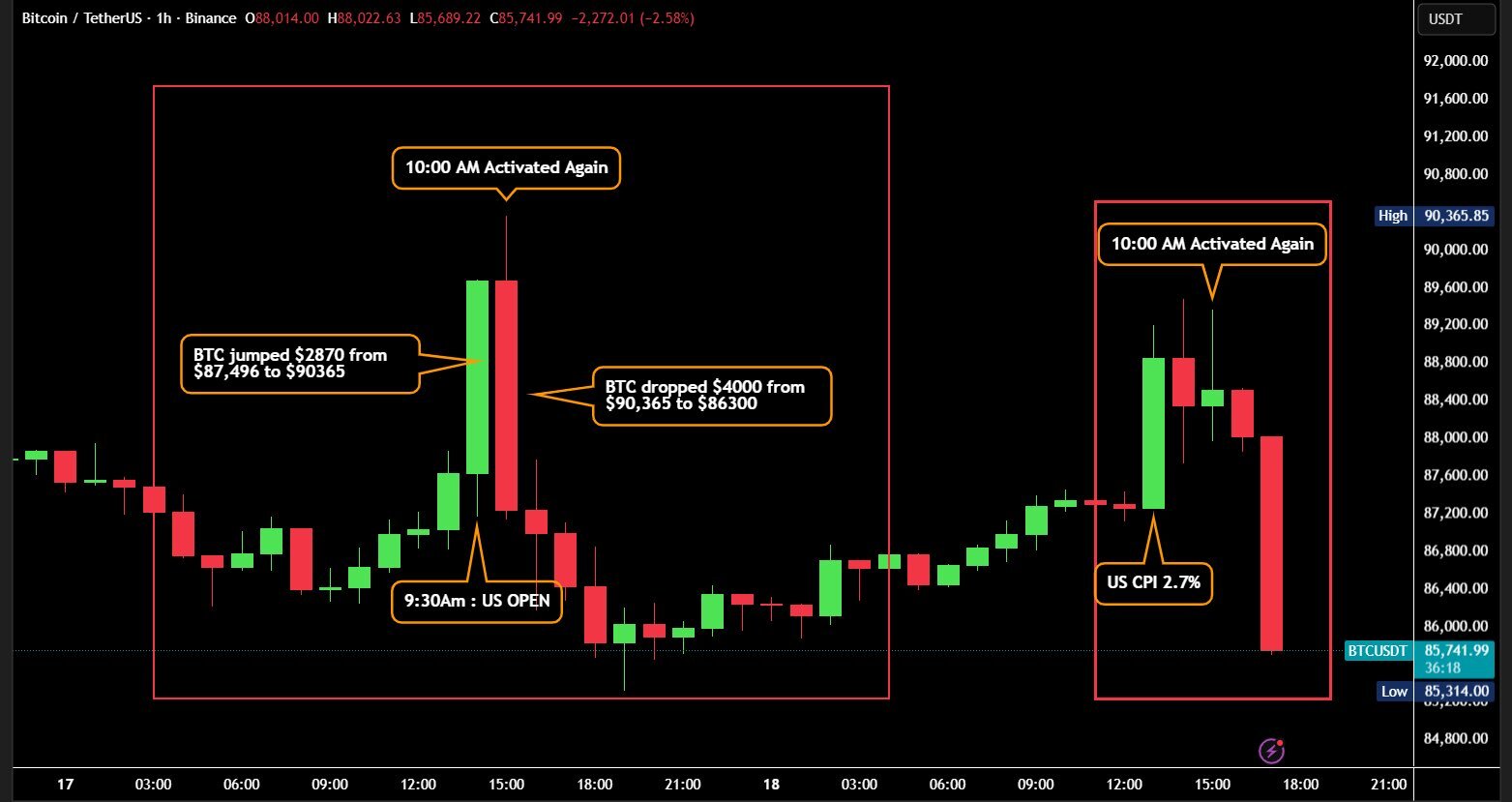
The whipsaw wasn't unique to Bitcoin. Ethereum experienced similar pattern, rallying 3.2% before dropping 4.8% from session highs. Total crypto market liquidations exceeded $200 million for the day across all assets.
Why Macro Releases Amplify Leverage Vulnerabilities
Scheduled economic data releases compress market dynamics in ways that expose structural fragility. Three factors converge simultaneously during CPI announcements that create conditions for violent reversals.
First, algorithmic trading systems execute identical strategies based on headline figures. The initial price move following CPI releases typically shows exaggerated momentum as automated systems react to deviation from consensus. This creates appearance of strong directional conviction that may not reflect underlying demand.
Second, discretionary traders pile into positions after seeing the first candle, often using leverage to maximize exposure. Retail traders particularly demonstrate this pattern, entering long positions with 10-20x leverage on perpetual futures after observing initial 2-3% moves. The leverage concentration builds rapidly in narrow price ranges.
Third, market makers withdraw liquidity precisely when order flow intensifies. Bid-ask spreads on Bitcoin spot and derivatives markets widened 40-60% during the 9:00am-11:00am window according to Kaiko market microstructure data. Market makers reduce position limits and increase spread buffers because macro releases create two-way volatility risk that standard models can't price efficiently.
This combination creates mechanical vulnerability. When price begins reversing through levels where leveraged longs cluster, forced liquidations become the marginal seller. Each liquidation pushes price into the next liquidation zone, creating cascading effect independent of macro fundamentals.
Liquidation Data Shows Mechanical Selling, Not Sentiment Shift
CoinGlass aggregates liquidation data across Binance, OKX, Bybit, and other major derivatives exchanges. The platform's December 11 data revealed liquidation patterns consistent with leverage cascade rather than macro reassessment.
Long liquidations concentrated in three distinct clusters: $90,000-$89,500 ($47 million), $88,800-$88,200 ($52 million), and $87,500-$86,800 ($29 million). These clusters correspond to psychological round numbers and previous consolidation ranges where traders typically set stop losses or hold leveraged positions.
The liquidation velocity matters as much as total size. The $88,800-$88,200 zone saw $52 million liquidated in approximately 12 minutes between 10:47am and 10:59am ET. This pace indicates automated exchange liquidation engines processing forced closes faster than market makers could absorb selling pressure.

Perpetual futures funding rates provide additional evidence. Funding dropped from +0.018% at 10:00am to -0.003% by 11:30am, indicating shift from leveraged long dominance to neutral or slight short bias. Open interest across Bitcoin perpetual futures fell 8.3% during the session according to data from The Block, confirming net position reduction rather than directional repositioning.
CPI Data Quality Issues Reduce Macro Conviction
Multiple financial outlets including Reuters and Financial Times published analysis questioning November CPI data reliability due to collection disruptions from a partial government shutdown in late October. The shutdown affected Bureau of Labor Statistics field operations during the survey reference period, potentially distorting seasonal adjustment factors.
RBC Capital Markets issued client note on December 11 cautioning that the softer-than-expected print might not represent clean disinflation signal. The note highlighted unusual divergences in housing and services components that could reflect data collection gaps rather than genuine price changes.
This uncertainty matters for explaining why macro-focused institutional buyers didn't sustain the rally. If large capital allocators view the CPI print as potentially distorted, they won't chase immediate price moves the way retail traders might. The absence of institutional follow-through left the rally supported primarily by leveraged retail positioning, the exact setup vulnerable to liquidation cascades.
Market Structure Explains More Than Macro Narrative
The lazy interpretation treats the reversal as proof CPI data "failed" or markets "didn't believe" the inflation story. This framing misses the mechanism. Bitcoin's price action on December 11 reflected interaction between macro catalyst and derivatives market structure, with structure dominating on intraday timeframe.
Crypto markets trade macro fundamentals through derivatives layer that includes perpetual futures funding, cross-exchange arbitrage, and liquidation mechanics. On high-volatility days surrounding scheduled data releases, this derivatives layer can overwhelm spot market price discovery for hours.
The counterargument is that large traders or "whales" deliberately pushed price into liquidation zones to profit from forced selling. This is possible—crypto's fragmented liquidity and lack of market maker obligations create opportunities for predatory trading that wouldn't work in deeper markets. However, you don't need conspiracy when market structure provides simpler explanation.
Traders added leverage into thin liquidity after CPI release. The book couldn't absorb the positioning. The unwind cascaded mechanically. No manipulation required, just predictable clearing of overleveraged positions.
What This Means for Positioning and Risk Management
For spot holders, this volatility represents noise rather than signal. The macro backdrop didn't fundamentally change between 10:00am and 12:00pm. November CPI showed continued disinflation even accounting for data quality concerns. Long-term spot positioning doesn't need adjustment based on intraday liquidation cascades.
For derivatives traders, the session provides clear lesson about sizing and timing around macro releases. If your liquidation level sits within the expected volatility range of a CPI candle, you're not trading a macro thesis—you're renting temporary exposure until market structure forces exit. Reduce leverage or avoid positions entirely during the 8:30am-12:00pm ET window on CPI days.
The forward signal to monitor is whether open interest rebuilds quickly or stays suppressed. Rapid rebuilding indicates traders learned nothing and volatility risk remains elevated. Sustained lower open interest suggests the market deleveraged meaningfully, potentially reducing near-term cascade risk.
Bitcoin's December 11 price action wasn't a macro reversal. Softer CPI should support risk assets through looser financial conditions pathway. The liquidation cascade resulted from leverage concentration meeting thin liquidity during scheduled volatility event. Macro set the direction, but market structure determined the path. On days like this, the path is where the damage happens.


.png)