


2025 is not just another strong year for crypto markets. It's the year capital concentration across centralized exchanges reached levels that are difficult to ignore. At the center stands Binance.
According to TokenInsight's 2025 exchange custody data, Binance now holds more than 72% of all crypto assets parked on major centralized exchanges. In absolute terms, that translates to $163.88 billion in average daily user assets throughout 2025, with peak levels exceeding $214.34 billion. Combining the average daily assets of the next seven largest centralized exchanges still doesn't surpass what Binance manages on a typical day.
This is not a marginal statistical detail. It's a structural change in how crypto capital is stored, managed, and concentrated.
The Gap Between Binance and Everyone Else
The scale of Binance's dominance becomes clearer when stacked against competitors. According to TokenInsight exchange-level custody data, OKX holds an average of $20.95 billion in user assets—second place, but roughly one-eighth of Binance's holdings. Bybit follows at $11.05 billion. Gate sits at $10.07 billion, Bitget at $7.15 billion, and established derivatives platforms like BitMEX and HTX hover near $5.5 billion each.
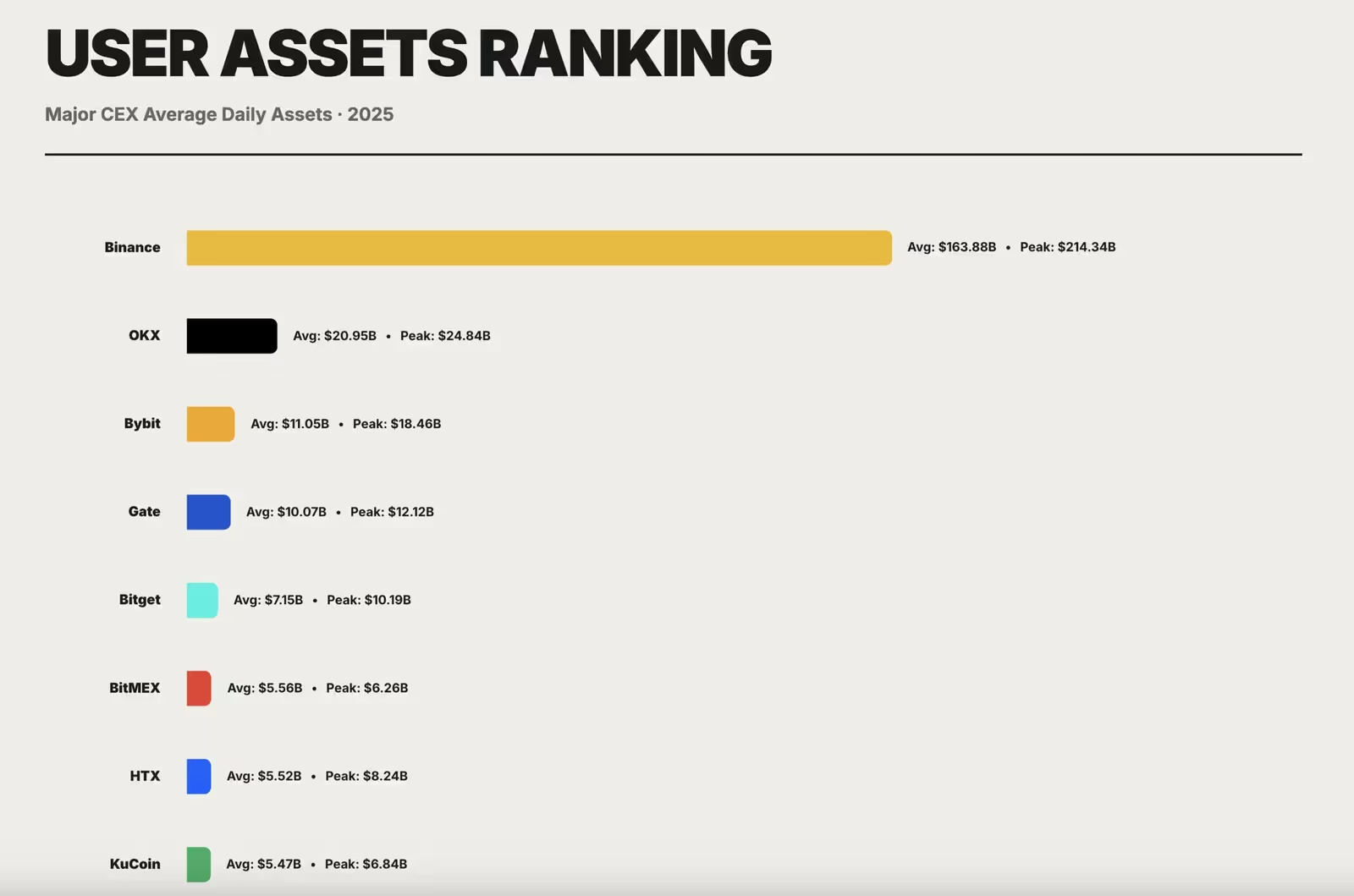
This is no longer a competitive lead. It's a structural gap. Market concentration measured by the Herfindahl-Hirschman Index (HHI) reaches approximately 5,352 for crypto exchange custody in 2025. In traditional financial markets, regulators classify anything above 2,500 as highly concentrated. Crypto custody now sits more than double that threshold.
Why Assets Keep Flowing to Binance
The accumulation isn't accidental. Capital flows where friction is lowest and liquidity is deepest.
According to CoinGlass derivatives data and institutional trading behavior analysis, Binance benefits from reinforcing advantages: deep spot and derivatives liquidity across thousands of pairs, global infrastructure with regional licensing in multiple jurisdictions, broad product coverage spanning trading, custody, and yield products, and an ecosystem that minimizes the need to move assets externally.
In volatile environments, large players prefer venues where execution risk is minimized. When you can trade, stake, lend, and custody on one platform with the tightest spreads, moving assets elsewhere introduces friction without clear benefit. In 2025, that preference translated into steady consolidation.
The Risk Profile the Market Avoids Discussing
There's another side to this concentration that most market commentary skips.
When one exchange effectively becomes the primary custodian for the majority of crypto assets, the risk profile of the entire ecosystem changes. This isn't about trading volume or temporary open interest spikes. These are real user assets sitting in exchange-controlled wallets—$163 billion on average, every day.
Any serious operational disruption, regulatory action, or technical failure wouldn't be a localized issue. It would ripple across the entire market. The 2022 FTX collapse demonstrated how quickly centralized exchange failure cascades through the ecosystem. Binance is not FTX—its operational history, reserve transparency, and regulatory settlements suggest different risk characteristics. But concentration risk exists independent of operational quality.
This is the paradox of crypto in 2025. An industry built on decentralization now relies heavily on centralized infrastructure at the custody layer.
Maturity or Warning Signal—Both Interpretations Have Merit
There are two ways to read this concentration.
One view sees it as market maturation. Capital gravitates toward efficient, liquid, and battle-tested infrastructure. Binance survived regulatory pressure, paid a $4.3 billion DOJ settlement in November 2023, and emerged with its market position strengthened rather than diminished. In this framing, dominance reflects trust, scale, and operational resilience earned through stress tests competitors didn't face.
The opposing view sees concentration as latent risk. When custody centralizes, systemic exposure increases regardless of operational quality. The crypto ecosystem's health becomes dependent on a single entity's continued stability. That dependency contradicts the asset class's founding premise.
History suggests both interpretations can coexist for long periods—until a stress test forces reassessment.
What 72% Actually Means
2025 will be remembered as the year crypto concentration stopped being theoretical and became numerical. The number is clear: 72% of centralized exchange assets sit on one platform. The next seven competitors combined hold less.
Whether this represents the foundation of more stable market structure or a vulnerability waiting to be tested will be decided in the next phase of the cycle. For now, the data tells a simple story.
Crypto assets aren't just growing. They're gathering. And they're gathering in one place.


.png)