


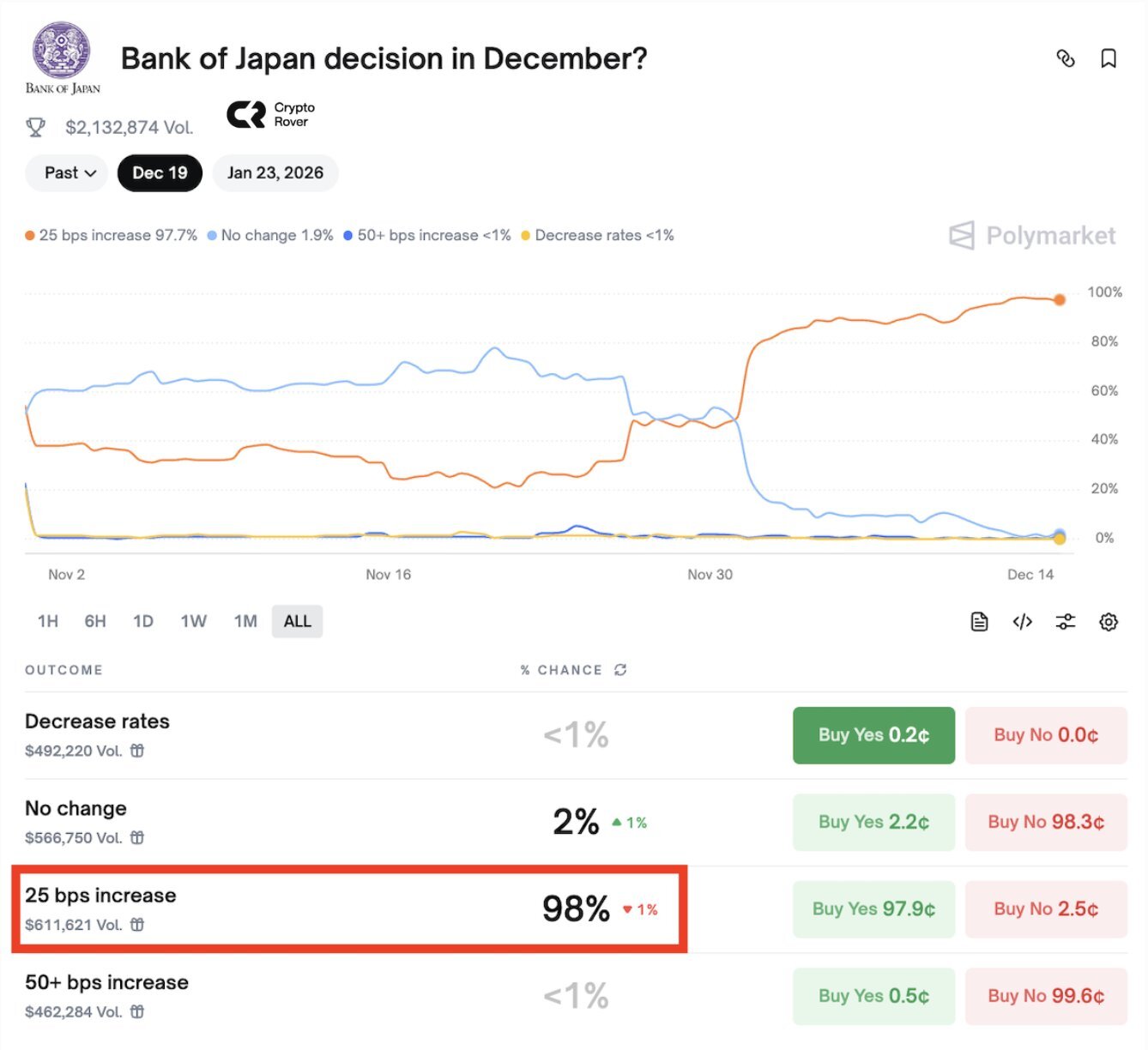
The Bank of Japan is widely expected to raise its policy rate 25 basis points to 0.75% in December, marking the highest level since the mid-1990s and potentially triggering Bitcoin's fourth significant drawdown in 18 months. Markets price approximately 85% probability of the hike according to overnight index swap rates, yet most crypto investors remain focused on Federal Reserve policy while missing the more immediate threat from Tokyo.
The concern stems not from the 25bp move itself but from structural unwinding of yen carry trades that financed global risk asset purchases throughout the ultra-low rate era. When Japan raises rates, capital flows reverse—yen strengthens, dollar liquidity contracts, leveraged positions face forced liquidation. Bitcoin has demonstrated consistent sensitivity to this dynamic despite narratives positioning it as independent from traditional financial plumbing.
Historical Pattern Shows Systematic Correlation
Bitcoin declined 23% following Japan's March 2024 exit from negative rates, fell 26% after July 2024's rate increase to 0.25%, and dropped 32% when rates moved to 0.50% in January 2025. The pattern suggests systematic correlation rather than coincidental timing, indicating Bitcoin remains vulnerable to Japanese monetary policy shifts regardless of improving fundamental adoption metrics.
Each episode followed similar pattern: Bank of Japan signals tightening, markets anticipate policy shift, yen begins strengthening, carry trades unwind, Bitcoin sells off sharply. The repetition suggests high probability of recurrence if December meeting produces expected 25bp hike.
Japan's Role as Global Liquidity Provider
Japan's monetary policy influence extends far beyond its domestic economy due to its role as world's largest foreign holder of U.S. Treasuries and historical provider of ultra-cheap funding for global carry trades. The country holds approximately $1.13 trillion in U.S. Treasury securities as of October 2025 according to Treasury Department data, representing roughly 14% of total foreign holdings.
For decades, near-zero and negative interest rates made yen the preferred funding currency for institutional carry trades. The mechanics proved straightforward: borrow yen at negative or near-zero rates, convert to dollars, deploy capital into higher-yielding assets including equities, bonds, and eventually cryptocurrency. The trade generated consistent returns as long as yen remained weak and rates stayed suppressed.
Bank of Japan policy normalization fundamentally disrupts this structure. When Japanese rates rise, carry trade economics deteriorate rapidly. Higher borrowing costs reduce spread advantages. Yen appreciation creates mark-to-market losses on unhedged positions. Risk managers respond by unwinding positions, selling higher-risk assets, repatriating capital to Japan.
The scale matters tremendously. Morgan Stanley research from August 2024 suggested approximately $20 trillion in cross-border yen-funded positions existed globally before July rate hike triggered partial unwinding. Even modest percentage repatriation represents hundreds of billions affecting asset prices across markets. Bitcoin sits at the extreme end of risk spectrum within these portfolios—when deleveraging begins, highest-risk positions liquidate first.
Three Previous Rate Hikes Triggered Consistent Bitcoin Declines
March 2024 marked Japan's historic exit from eight years of negative interest rates. The Bank of Japan raised policy rate from -0.10% to 0% to 0.10% on March 19, 2024. Bitcoin traded near $73,000 at announcement. Within six weeks, Bitcoin declined to approximately $56,500 by early May—a 22.6% drawdown coinciding with yen appreciation from 151 USD/JPY to 142 USD/JPY.
July 2024's rate increase to 0.25% on July 31 triggered sharper reaction. Bitcoin traded near $68,000 before decision. By August 5, Bitcoin crashed to $49,200—a 27.6% decline in five days. The rapid collapse coincided with violent yen appreciation from 153 USD/JPY to 141 USD/JPY as carry trades unwound in panic.
January 2025's rate hike to 0.50% announced January 24 produced the most severe drawdown. Bitcoin stood at $104,200 before decision. By February 11, Bitcoin fell to $70,800—a 32.1% decline. Yen strengthened from 155 USD/JPY to 147 USD/JPY, triggering sustained deleveraging rather than one-day panic.
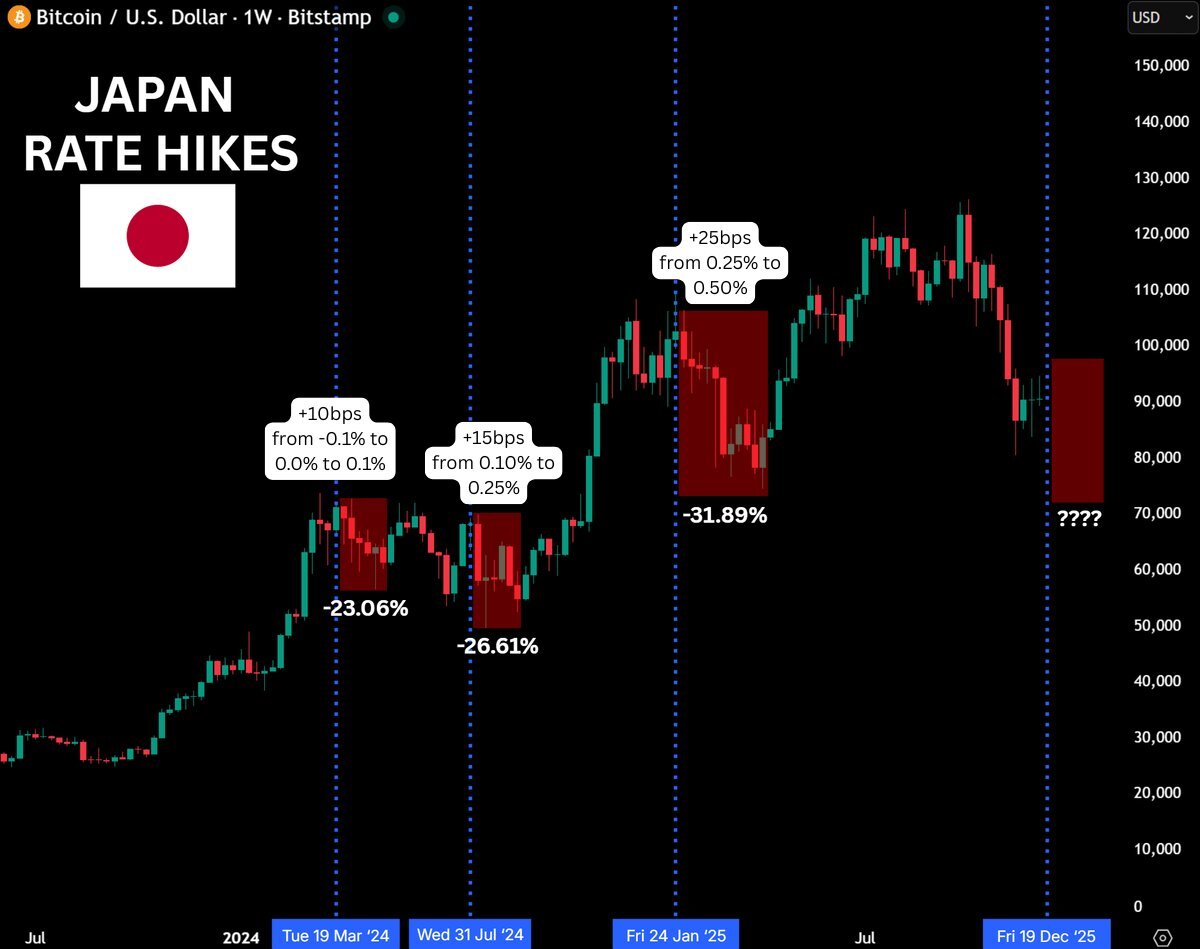
The consistency across three events indicates structural causation rather than coincidental timing. Each followed similar pattern establishing high probability of recurrence.
November Preview Showed Market Remains Sensitive
Markets provided advance warning November 30, 2025 when Bank of Japan Governor Kazuo Ueda delivered hawkish commentary strengthening December rate hike expectations. Bitcoin dropped from $96,800 to $83,200 over 72 hours—a 14% decline. Total cryptocurrency market capitalization fell from $3.45 trillion to $3.25 trillion, eliminating $200 billion in value.
The November selloff demonstrated markets now frontrun Bank of Japan decisions rather than waiting for announcements. However, the preview occurred with rate hike probability near 60%. Current probability sits above 85%. If December meeting confirms hike and Governor Ueda signals additional tightening ahead, reaction could prove more severe than November's preview.
Derivatives markets show increased hedging. Bitcoin put option open interest at $80,000 and $75,000 strikes increased 47% from November to December per Deribit data. Put/call ratios rose to 0.68 from 0.51. Funding rates on perpetual futures declined from +0.015% to +0.003%. These shifts suggest professional traders expect volatility even if directional conviction remains mixed.
Why 0.75% Represents Psychological Threshold
The 0.75% rate level carries significance beyond nominal basis points. Japan last maintained policy rates near 0.75% in 1995, thirty years ago in fundamentally different financial architecture. Today's market structure amplifies policy impacts through multiple channels.
Exchange-traded funds hold over $100 billion in Bitcoin across spot ETFs launched January 2024, creating institutional linkages to traditional finance. Derivatives open interest across Bitcoin futures and options exceeds $40 billion, representing massive leveraged exposure. Algorithmic trading systems execute based on correlation signals, risk parity frameworks, volatility targeting—mechanisms responding mechanically to liquidity shifts.
In this environment, small policy rate changes trigger disproportionate responses. A 25bp hike that would pass unnoticed in 1995 now propagates through interconnected leverage, derivatives hedging, systematic strategies. The psychological element matters equally. Markets spent decades conditioning on Japanese monetary accommodation. The shift toward tightening removes that safety net and forces repricing of risk across asset classes.
Bitcoin's Persistent Macro Sensitivity
Bitcoin's correlation with traditional risk assets increased substantially since 2020 despite improvements in fundamental adoption metrics. Spot ETF approval, institutional custody development, corporate treasury adoption should theoretically reduce macro sensitivity. Instead, Bitcoin's 90-day correlation with Nasdaq 100 averaged 0.72 through 2025, near highest levels in Bitcoin's history.
Several factors explain persistent sensitivity despite fundamental maturation. Institutional participation increased Bitcoin's integration into traditional portfolio frameworks. When institutions hold Bitcoin alongside equities and bonds, they apply similar risk management across holdings. Deleveraging decisions affect all risk assets simultaneously. Derivatives markets created mechanisms for expressing macro views through Bitcoin exposure. Algorithmic strategies treat Bitcoin as high-beta risk asset, mechanically adjusting exposure based on volatility and correlation signals.
The macro sensitivity doesn't invalidate Bitcoin's long-term fundamental case. Rather, it indicates short to medium-term price action remains heavily influenced by liquidity conditions regardless of improving fundamentals. Japanese monetary policy has minimal direct connection to Bitcoin's utility, yet demonstrably impacts price through global liquidity transmission channels.
Key Indicators to Monitor Through December Decision
Yen price action matters most. If USD/JPY breaks below 148 with momentum, carry trade unwinding accelerates. Yen strengthening to 145 or below indicates substantial capital repatriation with high correlation to risk asset selling. Conversely, if yen weakens or trades sideways after announcement, markets may have fully priced the event.
U.S. Treasury yield response indicates spillover. If 10-year yields spike 15-20 basis points following BoJ decision, that signals tightening financial conditions. Equity market reaction, particularly Nasdaq, will influence Bitcoin through correlation channels. Bitcoin-specific metrics including funding rates, open interest changes, exchange flows indicate whether crypto-native traders position defensively or opportunistically.
Three Potential Scenarios
Scenario 1: Policy fully priced, relief rally follows. Markets completely absorbed expectations through November selloff. Announcement produces buy-the-news response. Bitcoin rebounds toward $102,000-$105,000. Probability: 25%.
Scenario 2: Muted initial reaction, gradual grind lower. Rate hike announced as expected, limited immediate response. Over following weeks, yen gradually strengthens, risk assets drift lower. Bitcoin declines to $85,000-$88,000 over four to six weeks. Probability: 45%.
Scenario 3: Hawkish surprise triggers sharp selloff. Governor Ueda signals additional rate hikes in early 2026, yen surges, volatility spikes. Bitcoin breaks November lows quickly, cascades to $75,000-$78,000 within two weeks. Resembles August 2024 pattern. Probability: 30%.
These estimates reflect historical pattern frequency, current positioning, market structure. Baseline expectation suggests modest but extended weakness as most likely path. However, tail risks skew toward sharper downside rather than strong rally given technical setup and leverage positioning.
The Bank of Japan's expected 25 basis point rate hike to 0.75% represents more than routine policy adjustment. It signals unwinding of decades-long monetary accommodation that provided crucial funding for global risk asset purchases including Bitcoin. Historical pattern shows Bitcoin declining 23-32% following previous Bank of Japan tightening, establishing clear correlation between Japanese policy and crypto outcomes.
Current positioning shows increased caution but not panic. Technical structure remains vulnerable with incomplete recovery from November selloff. The critical variable will be yen price action and forward guidance. If USD/JPY breaks decisively lower and Ueda signals additional tightening, Bitcoin likely tests $75,000-$80,000 through Q1 2026. If yen stabilizes and policy tone remains measured, Bitcoin may consolidate without catastrophic breakdown.
What seems increasingly clear is Bitcoin's price action will continue responding to Japanese monetary policy regardless of fundamental improvements. The yen carry trade connection creates mechanical linkage between Tokyo policy decisions and crypto outcomes. Investors ignoring Bank of Japan while focusing solely on Federal Reserve miss crucial liquidity piece that has repeatedly moved Bitcoin markets over past 18 months. When Japan tightens, global liquidity contracts. And when global liquidity contracts, Bitcoin consistently sells off.


.png)