


Until late 2024, AI crypto tokens were the market's favorite story trade. Anything labeled AI, compute, data, agents, or infrastructure was priced as if it had already secured a dominant role in the future of artificial intelligence. Valuations expanded rapidly, narratives multiplied, and capital followed without resistance.
Twelve months later, that narrative has collapsed.
According to CoinMarketCap's AI & Big Data sector data as of December 23, the AI crypto sector is down roughly 66% year-to-date, wiping out an estimated $53 billion in combined market capitalization. What looked like a structural growth theme has turned into one of the most aggressive unwinds in recent crypto history.
This was not a routine pullback. It was a full repricing.
From AI Mania to a Hard Reset
To understand the scale of the damage, it helps to zoom out.
In 2023, the combined market cap of AI-related crypto tokens surged by 1,873% according to CoinMarketCap historical data, fueled by the global explosion of interest in artificial intelligence following ChatGPT's mainstream breakthrough. The crypto market rushed to attach itself to the AI boom, often without clear differentiation between infrastructure, middleware, and pure narrative plays.
In 2024, the trend continued at a slower pace with 157% gains. Capital remained supportive, and valuations stayed elevated despite limited evidence of real adoption.
Then 2025 arrived.
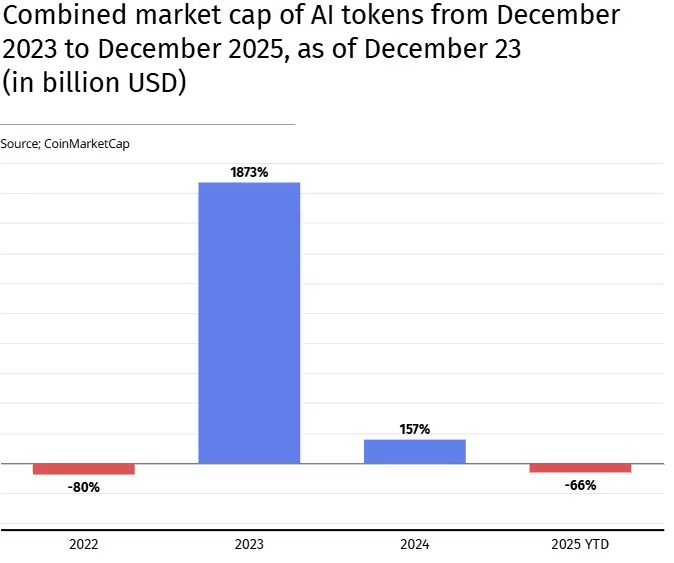
As macro conditions tightened and risk appetite across altcoins deteriorated, the AI crypto category entered forced deleveraging. Liquidity thinned, marginal buyers disappeared, and projects that relied heavily on narrative momentum lost support almost overnight.
The Selloff Hit Core Projects, Not Just Fringe Tokens
This was not a collapse confined to low-quality or obscure assets. Some of the most recognizable names in AI crypto absorbed the heaviest losses.
Render (RENDER), the decentralized GPU rendering network, is down roughly 82% YTD. The Graph (GRT), the indexing protocol for blockchain data, has fallen by a similar magnitude. Virtuals Protocol (VIRTUAL), an AI agent platform, is down approximately 73%.
These projects were widely viewed as foundational infrastructure for decentralized AI and data services. Yet in 2025, even perceived blue chips within the category failed to hold their valuations.
The message from the market was blunt: being associated with AI is no longer enough.
Why the Decline Was So Severe
Three structural factors explain why the AI crypto unwind turned violent.
First, valuations detached from real demand. Many AI tokens were priced on expectations rather than usage. When markets shifted toward capital preservation, tokens without consistent users, revenue, or fee generation were quickly abandoned. According to Token Terminal protocol revenue data, the gap between token valuations and measurable on-chain activity had widened to unsustainable levels by late 2024.
Second, oversupply fragmented capital. Throughout 2024 and early 2025, dozens of new AI-related projects launched. According to Messari's token issuance tracking, AI was among the most crowded categories in crypto during the past cycle. In a risk-off environment, that oversupply acted as an accelerant for downside pressure.
Third, broader risk-off conditions crushed narrative altcoins. As macro uncertainty increased and investors rotated toward Bitcoin and large-cap assets, narrative-driven altcoins suffered disproportionately. According to CoinGlass flow data, capital consistently exited high-beta narratives throughout 2025, and AI tokens were among the most exposed.
Does This Mark the End of AI Crypto?
This is where the debate becomes more nuanced.
Artificial intelligence as a technology is not slowing down. Global investment in AI infrastructure, data centers, GPUs, and compute continues to accelerate. NVIDIA's data center revenue and Microsoft's Azure AI spending both hit record levels in 2025. In traditional markets, capital deployment into AI remains aggressive and long-term.
The disconnect lies elsewhere.
The crypto market is no longer willing to assign massive premiums to AI exposure without proof of sustainable economic value. Tokens that cannot demonstrate real demand, defensible utility, or revenue generation are being repriced accordingly. According to Dune Analytics protocol metrics, the market is now distinguishing between AI narratives and AI business models.
2025 did not kill AI crypto. It killed the assumption that every AI-branded token deserves a premium valuation.
What Comes After the Reset
Post-collapse, the criteria have changed. Investors remaining in the space are no longer asking whether a project is "AI-powered." They're asking: Does it have real users? Does it generate fees or rely solely on token emissions? Can it survive without constant inflows of speculative capital?
The 66% drawdown is not just about losses. It's about maturity. Every major crypto cycle has followed a similar pattern: explosive narrative growth, excessive valuation, and then brutal reset. The AI crypto sector has now reached that reset phase.
What comes next will not resemble the hype of 2023. It will be slower, quieter, and far more demanding. According to historical market behavior tracked across previous cycles by Glassnode, that is usually when real infrastructure begins to matter.
The AI crypto boom is over. The AI crypto filter has just begun.


.png)