


Approximately 85% of tokens launched in 2025 trade below their initial valuation according to Memento Research analysis covering 118 token generation events through November. The average fully diluted valuation declined 71% from launch, with dozens of projects down 80-93% within months of going live on exchanges.
This isn't marginal underperformance from speculative micro-caps. Major launches including Berachain, Bio Protocol, Xterio, and Plasma experienced FDV collapses exceeding 89% despite significant marketing budgets, ecosystem narratives, and strong initial attention. The default outcome for 2025 token launches shifted from uncertain upside to documented downside.
What Memento Research Data Shows
The Memento Research dataset tracks economic reality rather than price speculation. For each of 118 launches, the analysis compares starting fully diluted valuation at TGE against current FDV, starting market capitalization versus current market cap, and percentage change across both metrics.
FDV represents theoretical total value if all tokens traded at current price. While not reflecting actual liquidity, FDV drives launch expectations and initial positioning. When tokens debut at $500 million to $2 billion FDV, markets implicitly price in substantial future growth to justify those valuations.
The data shows most 2025 launches failed that justification test immediately. Syndicate launched at $940 million FDV and currently trades at $59.8 million (-93.6%). Animecoin dropped from $870 million to $55.7 million (-93.6%). Berachain fell from $4.46 billion to $305 million (-93.2%). Bio Protocol declined from $2.06 billion to $143 million (-93.1%).
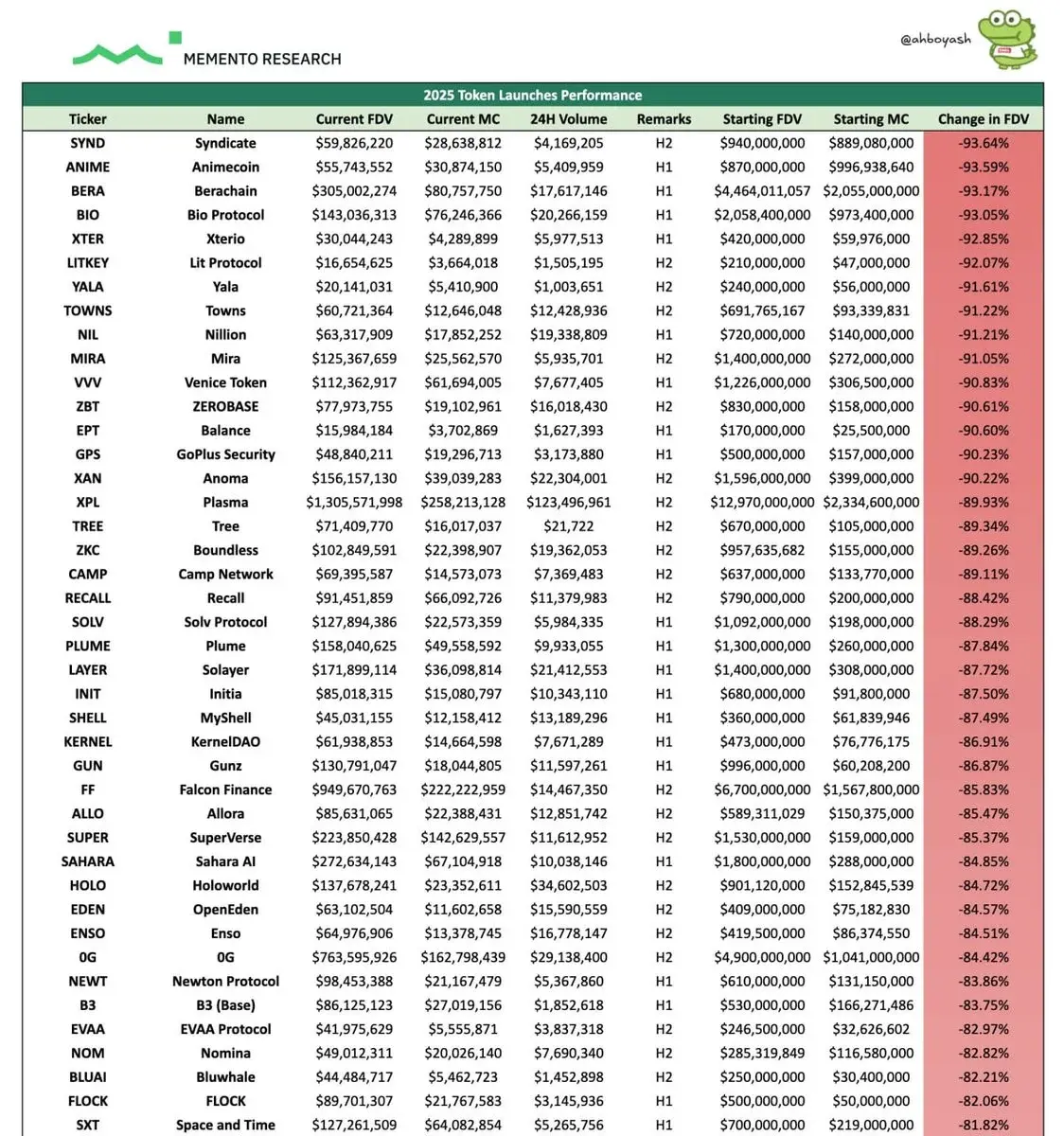
These weren't obscure experiments. Each received significant venture backing, professional marketing campaigns, and coordinated launch strategies across major exchanges. The collapses occurred despite, not because of lack of professional execution.
Why Launch Valuations Collapsed So Consistently
Four structural factors explain the systematic underperformance pattern rather than isolated failures.
Starting FDVs disconnected from fundamentals created immediate repricing risk. According to launch data aggregated across ecosystems, many tokens entered markets with valuations assuming user growth, revenue generation, or network effects that hadn't materialized. When those assumptions proved optimistic, markets repriced aggressively rather than waiting for potential future delivery.
Low circulating supply at launch masked underlying weakness. Most 2025 TGEs released 5-15% of total supply initially, creating artificial scarcity during first trading sessions. This produced appearance of price stability or strength while actual liquidity remained extremely thin. According to market microstructure analysis, even modest selling pressure triggers disproportionate moves when float is restricted.
Continuous unlock pressure prevented price recovery. Even without large cliff unlocks, steady token releases through ecosystem incentives, contributor vesting, and airdrop distributions created constant selling. Markets began pricing in this predictable dilution more aggressively than previous cycles, front-running inevitable supply increases.
Launch timing represented peak attention rather than early discovery. In 2021-2022, TGEs often marked beginning of price discovery as retail learned about projects. By 2025, public launch frequently represented conclusion of hype cycle. Early investors, insiders, and airdrop recipients were already positioned before exchanges listed tokens, leaving public buyers as exit liquidity rather than early participants.
The FDV Illusion That Traps Investors
The most persistent error investors made in 2025 was treating fully diluted valuation as real value rather than theoretical construct. FDV assumes all tokens trade at current market price simultaneously, but this capital doesn't exist in practice.
According to historical trading data across token launches, actual market depth represents tiny fraction of FDV during early trading. A token showing $1 billion FDV might have only $5-10 million in genuine buy-side liquidity within 10% of current price. When sentiment shifts or unlock events approach, the gap between theoretical valuation and actual available liquidity closes violently through price decline.
This dynamic explains why tokens can maintain elevated FDV for weeks before collapsing 70-80% in days. The illusion persists until enough holders attempt to realize gains simultaneously, discovering insufficient demand exists at elevated prices.
The 15% That Survived and Why
Approximately 15% of 2025 launches held or exceeded starting valuations according to Memento Research data. These outliers shared consistent characteristics worth examining.
Lower initial FDV relative to comparable projects reduced repricing pressure. Tokens launching at $50-200 million FDV faced lower bars for justifying valuations through user growth or revenue compared to billion-dollar debuts. The smaller starting point provided room for positive surprises rather than requiring perfect execution just to maintain launch price.
Demonstrable product-market fit before launch changed fundamentals. Projects showing sustainable on-chain activity, revenue generation, or user retention metrics before TGE provided evidence supporting valuations rather than promises. According to comparative performance analysis, tokens with 6+ months of operational history before launching outperformed those rushing to market.
Higher circulating supply at launch (25-40%) reduced unlock overhang. When meaningful portion of supply traded immediately, markets gained better price discovery and reduced fear of future dilution events. This created more stable trading patterns even if initial volatility increased.
What Changed in 2025 Market Structure
The systematic underperformance reflects broader market evolution rather than temporary conditions. Capital allocation grew more selective as investors learned from 2021-2022 patterns. Narrative alone no longer sustains elevated valuations without supporting fundamentals.
According to market participant observations, institutional allocators and sophisticated retail both shifted from buying launches blindly to requiring proof of concept before committing capital. This behavioral change means tokens face immediate scrutiny rather than benefit-of-doubt periods that previously lasted months.
The venture capital overhang also matters. With hundreds of projects raising at high private valuations in 2021-2023 now reaching unlock periods, selling pressure from early investors compounds public market challenges. This creates structural headwind independent of individual project quality.
Implications for Token Launch Strategy
The data suggests several conclusions for projects planning launches and investors evaluating opportunities.
For projects, launching at conservative FDV appears critical. The 15% that succeeded avoided billion-dollar debuts in favor of valuations justifiable by current rather than projected metrics. Lower starting points provide room for growth rather than requiring perfect execution to avoid collapse.
For investors, the risk-reward at TGE has inverted from previous cycles. When 85% of launches decline 71% on average, buying at launch carries documented downside. Waiting 3-6 months for price discovery and unlock events to clear often provides better entry points at lower valuations.
The counterargument is that the successful 15% still generated returns justifying risk. However, identifying winners before launch requires accurate fundamental analysis that most investors lack access to during pre-launch information asymmetry.
When 85% of 118 analyzed token launches trade below starting FDV with 71% average decline, explanations shift from isolated failures to structural market changes. Launch mechanics, valuation practices, and capital allocation patterns all evolved unfavorably for TGE participants.
Token generation events no longer provide shortcuts to upside. They represent risk events requiring discipline, patience, and willingness to wait for genuine price discovery. The 2025 data eliminates ambiguity: buying launches blindly is exposure to systematic downside, not investing.
Markets teach through pain when lessons aren't learned voluntarily. The 85% underwater provides that education clearly for anyone paying attention to evidence rather than narratives.


.png)