

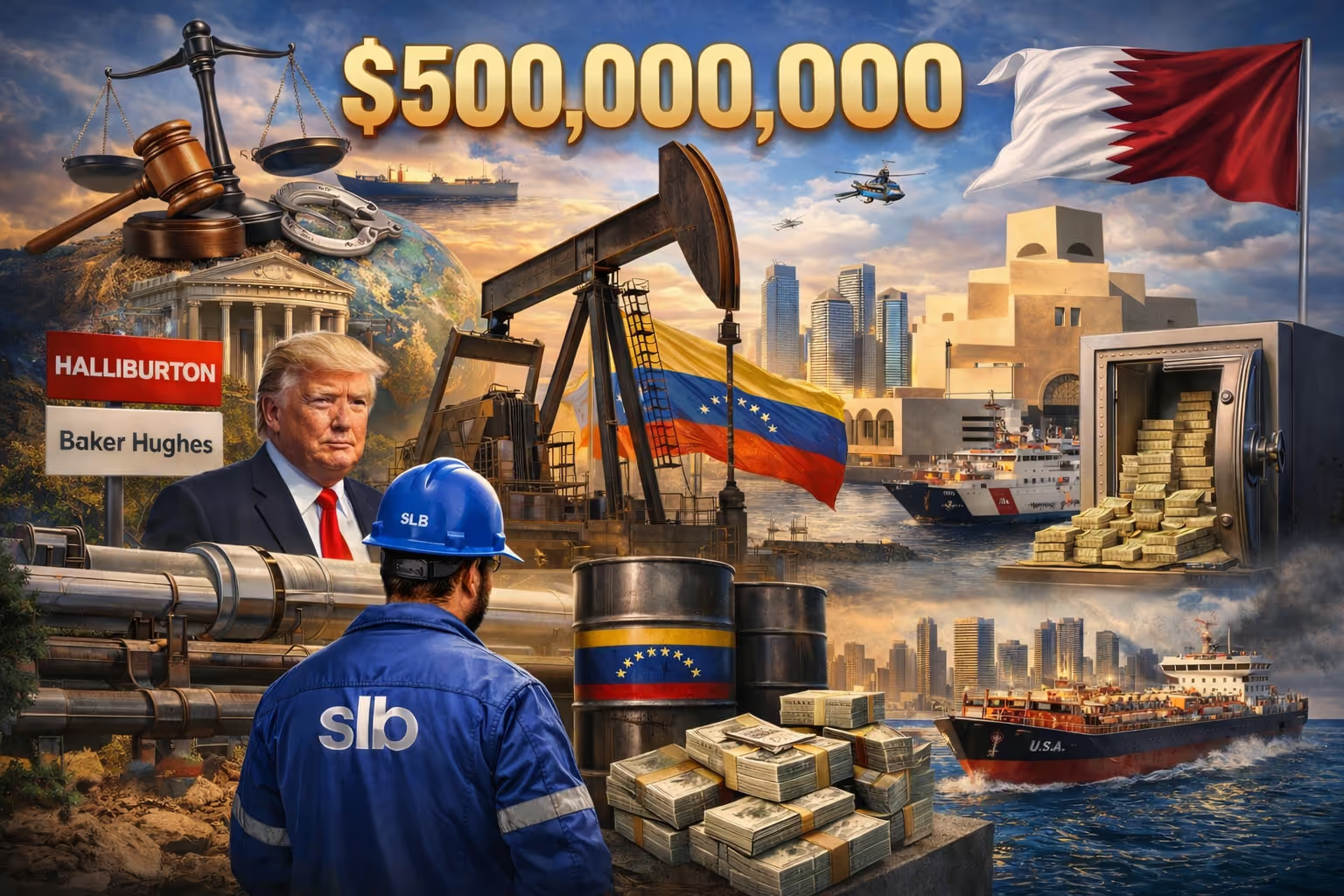
A single number explains why this story matters: $500 million. That is the reported value of the first completed US-supervised sale of Venezuelan oil, with proceeds placed into US-controlled accounts designed to reduce the risk that creditors seize the cash before it can be deployed for policy goals. The market headline is "oil sale." The real headline is that sanctions enforcement is evolving into cash management.
President Trump signed Executive Order 14373 on January 9, 2026, titled "Safeguarding Venezuelan Oil Revenue for the Good of the American and Venezuelan People." The order declares that attempts to attach or reach revenues in US government custody derived from Venezuelan natural resources constitute an unusual and extraordinary threat to US national security according to Mayer Brown's analysis. This is not a feel-good mechanism. It is a pragmatic response to a predictable constraint.
The Mechanism Controls Who Holds the Cash, Not Who Buys the Crude
The most important element is the routing: proceeds held in US Treasury accounts rather than sitting in structures that creditors can more easily attach. The White House framed the policy as safeguarding oil revenue for broader purposes and limiting the ability of claimants to intercept funds.
From a market perspective, the buyer matters less than the settlement rails. If proceeds are effectively escrowed under US influence, the oil sale becomes a sanctioned corridor where barrels move but cash remains constrained. Sanctions are no longer just "ban the transaction." They have become "allow the transaction, but define custody and settlement."
President Trump announced Venezuela will provide between 30 million and 50 million barrels of oil to the United States for sale at market prices according to Morgan Lewis reporting. The Department of Energy stated that the United States is "selectively rolling back sanctions to enable the transport and sale of Venezuelan crude and oil products to global markets" according to Sullivan and Cromwell.
Three Forces Driving This Shift
First, sanctions architecture is moving from blanket bans to conditional waivers. OFAC has issued narrow general licenses and case-specific authorizations in recent years, primarily tied to oil trading, debt restructuring, and limited upstream activity. These authorizations remain both conditional and revocable.
Second, the creditor overhang is real. Venezuela and PDVSA have faced years of claims tied to expropriations and defaults. In the US, litigation around Venezuelan assets has been extensive, with creditor strategies often aimed at attachable value. The Crystallex dispute and related enforcement pathways represent a concrete reference point. Making cash flow normally was a non-starter if Washington wanted proceeds to remain usable.
Third, energy markets reward reliability more than politics. Even when Venezuela is not a swing producer, incremental barrels can matter at the margin when geopolitics tightens supply options. The US approach appears designed to permit flows while keeping political and financial control.
On January 7, 2026, the White House announced that the secretary of energy is implementing a deal to acquire Venezuelan oil and transport it to the United States for sale according to Morgan Lewis. The administration stated that the United States would authorize the import into Venezuela of oil field equipment, parts, and services to facilitate modernization and expansion of production capabilities.
What Changes for Markets and What Does Not
For oil traders, the takeaway is not "Venezuela is back." It is narrower: flows can be enabled through highly structured channels. That can reduce immediate supply uncertainty, but it also creates a new risk category called policy plumbing risk.
If proceeds are trapped in controlled accounts, incentive alignment changes. The seller may receive less economic benefit in the short run, which can constrain reinvestment and production maintenance. Meanwhile, buyers must price in the risk that permissions tighten, renewals lapse, or the settlement architecture changes.
It also interacts with OFAC's broader licensing posture. The Treasury Department sanctioned four companies on December 31, 2025, for operating in Venezuela's oil sector and identified four associated oil tankers as blocked property. Treasury Secretary Scott Bessent stated that "those involved in the Venezuelan oil trade continue to face significant sanctions risks."
The market impact is not a simple "more supply equals lower prices." Supply may be available, but the system is still gate-kept by compliance conditions, account controls, and political triggers.
The Counterargument: This Can Still Be Gamed
The bullish read is that controlled accounts prevent chaotic creditor grabs and keep the situation orderly. The skeptical read is that it institutionalizes a workaround without solving the underlying debt and governance issues.
There are at least two problems with the optimistic framing. First, it can chill long-term investment. If the producer cannot reliably access revenue, maintenance capex and operational continuity become harder. That reduces the probability of a durable production recovery. Second, it can invite parallel structures. When official channels become too constrained, actors search for off-ramps.
Washington is effectively betting that controlled settlement is still preferable to either zero exports or uncontrolled cash flows. That might be the least bad option, but it is not a clean win.
According to Cleary Gottlieb, all Venezuela sanctions remain in place, including those prohibiting transactions and activities involving the Government of Venezuela, PDVSA, Minerven, and the oil and gas sector. The remaining leadership of Maduro's administration includes multiple SDNs with whom US persons are prohibited from dealing absent OFAC authorization.
What to Watch Next
Three things will indicate whether this becomes a template or a one-off. First, watch renewal cadence and scope creep: do controlled-account arrangements expand beyond the initial sale and become standard for additional cargoes? Second, monitor licensing language from OFAC for any amendments that clarify who can transact, on what terms, and under what reporting obligations. Third, observe creditor litigation posture: watch whether creditors adjust strategies toward the new revenue channels or focus on other attachable assets.
The point is not that sanctions are weakening. The point is that sanctions are getting more operational. The US is trying to preserve leverage while reducing chaos. A $500 million oil sale is the headline, but the structural change is the settlement architecture: who holds the cash, where it sits, and who can touch it.


.png)