


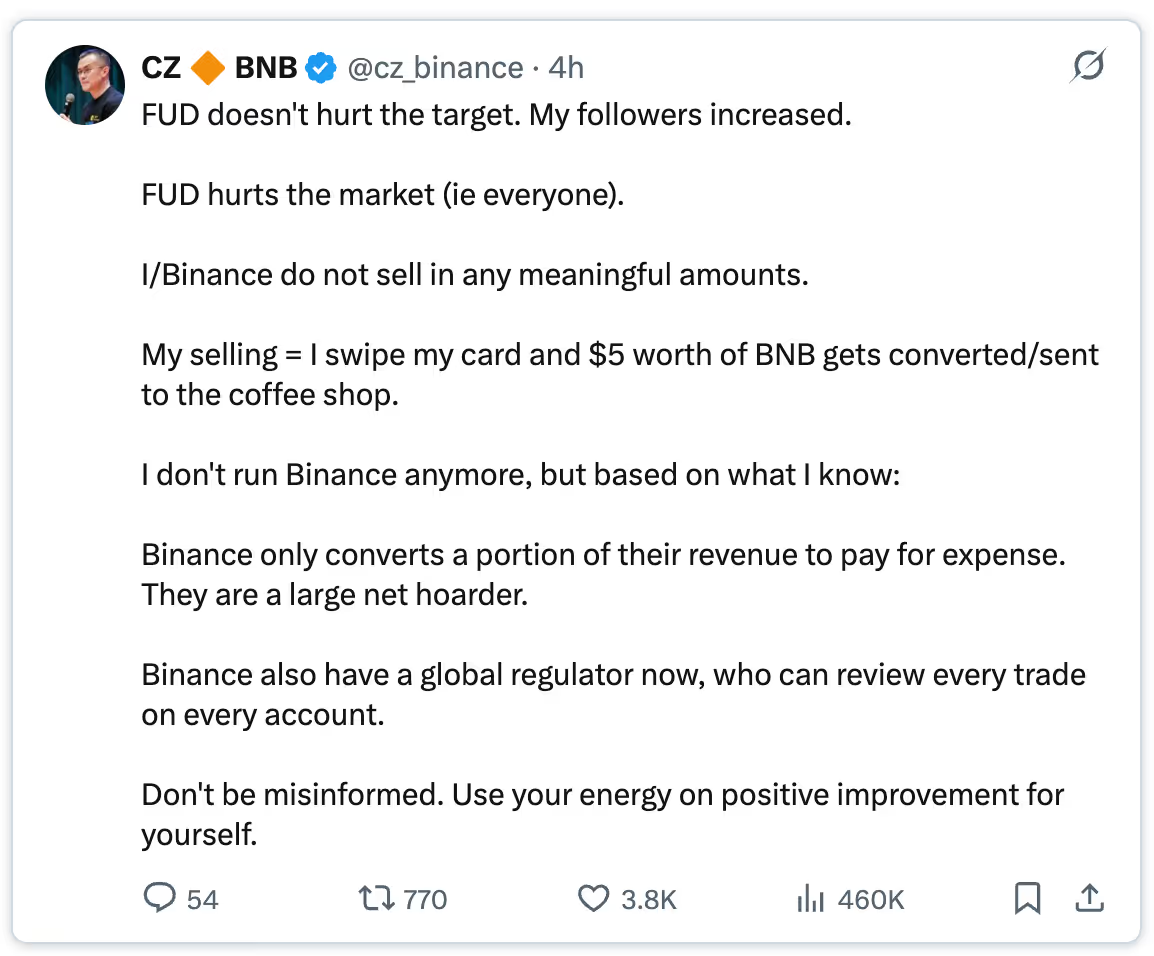
Rumors move faster than flows in crypto. A single viral claim about a major exchange “dumping” can do real damage before anyone checks whether the story is even mechanically plausible. That is the backdrop for Changpeng Zhao’s latest response on X, where he denied meaningful selling by himself or Binance and argued that fear-driven narratives end up hurting the broader market.
At the same time, Binance published an open letter to the crypto community that reads like a direct attempt to answer the underlying anxiety: what the exchange is doing on risk controls, reserves, enforcement cooperation, and what it plans to do with its SAFU protection fund.

Put together, the message is simple. CZ is denying the selling narrative. Binance is trying to make its credibility measurable.
What CZ actually said
CZ’s post is blunt by crypto standards. He wrote that “FUD hurts the market (ie everyone)” and that he and Binance “do not sell in any meaningful amounts.” He also described his personal selling as incidental conversion tied to everyday spending, and reminded readers he does not run Binance anymore. Those points are designed to attack the core allegation from two angles: intent and capability. If he is not operating the exchange, and if his activity is small, the rumor loses its main villain.
That does not automatically make the rumor false. But it does force the conversation into verifiable territory. If a large venue is “selling,” there should be observable evidence somewhere: in reserves reporting, wallet movements, or market structure.
Why “Binance is selling” narratives hit harder than normal crypto noise
Binance sits at the center of crypto liquidity. When traders believe an exchange is unloading inventory, it triggers a chain reaction:
- People sell first and ask questions later
- Perps and margined positions de-risk aggressively
- Market makers widen spreads and pull size
- A rumor becomes a liquidity event
This is why these stories matter even when they are wrong. They do not need to be true to cause damage. They only need to be believed long enough for positioning to unwind.
Binance’s open letter is not a denial. It is a positioning statement
Binance’s community letter does not directly argue with the “selling” rumor line by line. Instead it tries to shift the frame toward governance and measurable safeguards. It highlights four areas from 2025: risk controls, compliance cooperation, ecosystem activity, and reserves transparency.
Binance claims it helped users recover funds from incorrect deposits in 38,648 cases totaling $48 million during 2025, and says cumulative incorrect-deposit recoveries exceed $1.09 billion. Binance also claims it assisted 5.4 million users with identifying potential risks and prevented about $6.69 billion in scam-related losses.
On enforcement cooperation, Binance claims collaboration with global law enforcement led to authorities confiscating $131 million in illicit funds. On listings and ecosystem breadth, it says its spot listings in 2025 spanned 21 public blockchains, and that 13 of those chains were newly launched.
On reserves, Binance states its proof-of-reserves showed user assets of approximately $162.8 billion “fully backed,” covering 45 assets by the end of 2025.
Even if you treat these as self-reported marketing claims, the intent is clear. Binance is trying to reassure the market using operational metrics, not vibes.
The SAFU change is the most important part of the letter
The single most material announcement in the letter is the SAFU update.
Binance says it will convert the SAFU fund’s $1 billion stablecoin reserves into Bitcoin, with the conversion planned to complete within 30 days of the announcement. Binance also outlines a rebalancing rule: it will monitor the SAFU fund’s market value and if that value falls below $800 million due to BTC price fluctuations, it will rebalance the fund back to $1 billion.
This is not just a symbolic headline. It tells you how Binance wants users to think about backstops and credit risk.
Moving SAFU toward BTC concentrates volatility risk but aligns the fund with what Binance calls the “core asset” of the ecosystem. The $800 million trigger matters because it implies Binance expects BTC drawdowns to be possible and is pre-committing to a replenishment mechanism rather than leaving the fund’s size to market drift.
If you are reading this as a trader, the point is not whether you like BTC or stablecoins more. The point is that Binance is putting structure around its insurance narrative, and doing it publicly, during a period where credibility is being questioned.
What this changes for the “selling” rumor conversation
A big part of the selling rumor genre is the insinuation that an exchange can quietly offload reserves without anyone noticing. Binance’s letter is essentially telling the market: here is what we claim about reserves, risk controls, and SAFU structure.
Again, it is still a claim. But it narrows the argument. If an exchange says it is fully backed across specific assets and is actively managing a public protection fund with stated thresholds, then any accusation of hidden dumping needs to contend with those disclosures.
That is a higher bar than “trust me bro.”
How to evaluate exchange-selling claims without guessing
If you want to treat this like an analyst, not a participant in a rumor cycle, focus on process.
Check what is being alleged
Is the claim about selling user assets, selling treasury assets, or selling a token like BNB to fund operations. Those are different accusations with different implications.
Check what you can verify
If a venue publishes proof-of-reserves or similar reporting, read how it is constructed and what it covers. It can support confidence, but it rarely answers every question a skeptic might ask.
Check wallet behavior, but do not over-interpret it
Large exchanges move funds for custody management, user withdrawals, and internal security procedures. Transfers are data, not automatically evidence of selling.
Check the market structure
If price action looks like a leverage flush, a rumor may be the story people attach to it, not the cause.
The skeptical view still matters
A thorough analysis cannot stop at “CZ denied it and Binance posted a letter.”
Crypto has a long history of trust failures. Many users have learned the hard way that credibility is not earned through statements. It is earned through survival, transparency, and behavior over time.
Binance’s metrics are self-reported. Proof-of-reserves, while helpful, has known limitations in what it can guarantee at any given moment. SAFU is a strong narrative tool, but it does not remove all forms of platform risk.
So the correct stance is not blind trust. It is disciplined reading.
CZ’s denial addresses the rumor directly. Binance’s letter attempts to address the deeper issue that makes the rumor believable in the first place: market sensitivity to centralized exchange risk.
What to watch next
If Binance follows through on the SAFU conversion and continues to publish consistent reserves reporting, the market’s baseline trust can improve at the margin. If Binance’s disclosures become inconsistent, or if users observe behavior that contradicts the stated framework, the rumor cycle will intensify again.
Crypto is not short on narratives. The only edge is learning to separate narratives from mechanics.


.png)